3739 words
19 min read
View
Week 1 - Graded Assignment 1
Course: Jan 2026 - Mathematics I
Week 1 - Graded Assignment 1
Topic: Relations | Marks: 1
Question 1
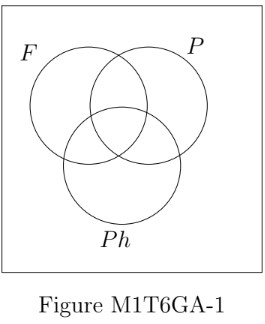
A survey was conducted on pollution of 525 ponds across some cities. It was found that 230 ponds are polluted by fertilisers , 245 ponds are polluted by pesticides and 257 ponds are polluted by pharmaceutical products . 100 ponds are polluted by fertilisers and pesticides, 82 ponds are polluted by fertilisers and pharmaceutical products, 77 ponds are polluted by pesticides and pharmaceutical products.
- Relation is reflexive.
- Relation is transitive.
- Relation is symmetric.
- This is an equivalence relation.
Status: Yes, the answer is correct.
Score: Score: 1
Accepted Answers:
Relation is transitive.
Relation is symmetric.
Solution
[!solution]+ Abstract Solution (Strategy)
- [Relation Property Logic]: Let be the subset of ponds polluted by . A pond relates to () if and only if and .
- [Symmetry]: Does ? Yes, because the condition is commutative.
- [Transitivity]: If and , then holds inherently by set membership.
- [Reflexivity Constraint]: For reflexivity, every pond in the universe (525 ponds) must be in .
Procedure
- Step 1: Identify that not all 525 ponds are in the set (). Thus, if pond , then . Reflexivity fails.
- Step 2: If Pond A and Pond B are in the polluted list, then Pond B and Pond A are in the polluted list. Symmetry holds.
- Step 3: If A & B are polluted, and B & C are polluted, then A & C are polluted. Transitivity holds.
- Step 4: Since it is not reflexive, it is not an equivalence relation.
- Result: Transitive and Symmetric.
Topic: Equivalence Relations | Marks: 1
Question 2
Consider the relation on the set . Which of the following is/are true?
- is a transitive relation.
- is a function.
- is not an equivalence relation.
- is a reflexive relation.
- is a symmetric relation.
Status: Yes, the answer is correct.
Score: Score: 1
Accepted Answers:
is a transitive relation.
is a function.
is a reflexive relation.
is a symmetric relation.
Solution
[!solution]+ Abstract Solution (Strategy)
- [Simplification]: The condition simplifies to .
- [Axiom Testing]: Test the identity rule against the definitions of Reflexivity, Symmetry, and Transitivity.
- [Function Mapping]: For each , determine if there is exactly one .
Procedure
- Step 1 (Reflexive): is true for all .
- Step 2 (Symmetric): If , then .
- Step 3 (Transitive): If and , then .
- Step 4 (Function): The relation assigns a unique output for every input.
- Result: Reflexive, Symmetric, Transitive (Equivalence) and Function.
Topic: Functions | Marks: 1
Question 3
Which of the following relations is/are one-one function?
Status: Yes, the answer is correct.
Score: Score: 1
Accepted Answers:
Solution
[!solution]+ Abstract Solution (Strategy)
- [Eliminate Non-Functions]: Relations involving inequalities () assign multiple values to a single . These are not functions.
- [Injectivity Test]: A function is one-one if .
Procedure
- Step 1: are inequalities. For a fixed , multiple 's satisfy the relation. Fails function test.
- Step 2: Evaluate : . If , can be or . Not one-one.
- Step 3: Evaluate : . This is a linear function; every yields a unique , and every yields a unique .
- Result: is a one-one function.
Topic: Mapping Properties | Marks: 1
Question 4
Which of the following is/are true?
- Function such that is not onto.
- Relation on a set is a function.
- Function such that is not one-one.
- Function such that is one- one and onto.
Status: Yes, the answer is correct.
Score: Score: 1
Accepted Answers:
Function such that is not onto.
Function such that is not one-one.
Solution
[!solution]+ Abstract Solution (Strategy)
- [Onto Test]: Does the set of outputs (Range) cover the entire target set (Codomain)?
- [One-one Test]: Does different inputs produce different outputs?
Procedure
- Step 1: on . The range is which does not include negative numbers or fractions in . Not onto (True).
- Step 2: maps and . Fails function test (unique image).
- Step 3: . and . Fails one-one test. Not one-one (True).
- Step 4: fails both (similar to ).
- Result: Options 1 and 3 are correct.
Topic: Set Cardinality | Marks: 1
Question 5
Consider the following sets,
Find the cardinality of the set .
Your Answer:
35Status: Yes, the answer is correct.
Score: Score: 1
Accepted Answers:
35
Solution
Abstract Solution (Strategy)
- [Calculate Integer Overlap]: Find Natural numbers within the bounds of .
- [Execute Subtraction]: Remove any Natural numbers falling within the range specified by .
Procedure
- Step 1: .
- Step 2: contains all rational numbers in . This includes the integers .
- Step 3: Remove those integers from the set.
- Step 4: Integers in = 11. Integers in = .
- Step 5: Total remaining = .
- Result: 35
Topic: Set Theory (PIE) | Marks: 1
Question 6
Pollution Survey Analysis. Using the data from Question 1, find the number of ponds polluted by all three types of water contaminants (Fertilisers, Pesticides, and Pharmaceutical products).
Your Answer:
52Status: Yes, the answer is correct.
Score: Score: 1
Accepted Answers:
52
Solution
Abstract Solution (Strategy)
- [Principle of Inclusion-Exclusion]: For three overlapping sets , the total union is given by:
- [Variable Isolation]: Solve for the unknown intersection .
Procedure
- Step 1: Identify Union .
- Step 2: Individual Counts: .
- Step 3: Intersection Pairs: .
- Step 4: Substitute:
- Step 5**: .
- Result: 52
Topic: Set Functions | Marks: 1
Question 7
Family Tree Functions. Mahesh has four sons (Shubh, Rabi, Mahendra, and Rajat). Shubh has two sons (Yashubh and Navrtna). Rabi has two sons named Rathi and Rakesh. Let where (the set of all family members). Which of the following are correct?
- is a function, where and .
- If is a function, where and , then is one-one.
- If is a function, where and , then is onto.
- If is a function, where and , then is bijective.
Solution
Abstract Solution (Strategy)
- [Functional Mapping]: A relation is a function if every element in the domain maps to exactly one element in the codomain.
- [Injectivity (One-One)]: Does each son in have a unique father in ? (In a standard tree, Yes).
- [Surjectivity (Onto)]: Is every father in linked to at least one son in ?
Procedure
- Step 1: Test . Mahesh has no father in the set . Thus, he has no image. Not a function.
- Step 2: If is the set of 4 grandsons, each has exactly one parent in . Since no two grandsons in share the same father across the different families mapping to , we check: Yashubh & Navrtna map to Shubh. Rathi & Rakesh map to Rabi.
- Step 3 (Onto): If , both are mapped to by the grandsons. Onto holds.
- Step 4 (Bijection): If and , then Yashubh Shubh and Rathi Rabi. This is a one-to-one correspondence. Bijective holds.
- Result: Options 2, 3, and 4 are correct.
Topic: Function Properties | Marks: 1
Question 8
Dielectric Mapping. Consider the function from the set of materials to the set of dielectric values . Which of the following is true?
- is neither one to one nor onto.
- is one to one but not onto.
- is onto but not one to one.
- is bijective.
Solution
Abstract Solution (Strategy)
- [Direct Comparison]: Compare the cardinality of the domain and the range.
- [Correspondence Check]: Determine if each material maps to a unique, distinct value.
Procedure
- Step 1: Count elements in Material set () and Value set ().
- Step 2: Each material is assigned exactly one constant from the table.
- Step 3: No dielectric constant repeats for different materials in this specific set.
- Step 4: Since is both injective and surjective (), it is bijective.
- Result: Bijective.
Topic: Set Operations | Marks: 1
Question 9
Cardinality of Multiples. Consider:
Find the cardinality of .
Your Answer:
11Solution
Abstract Solution (Strategy)
- [Enumerate Sets]: Explicitly list all elements in .
- [Exclusive Regions]: Calculate the "Only A", "Only B", and "Only C" parts of the Venn diagram and sum their sizes.
Procedure
- Step 1: .
- Step 2: .
- Step 3: .
- Step 4: Find overlaps: , , .
- Step 5:
- (Count = 4)
- (Count = 3)
- (Count = 4)
- Step 6: Total = .
- Result: 11
Topic: Venn Diagrams | Marks: 1
Question 10
Netflix Viewing Stats. Total group: 180.
- Dabangg (): 95
- Avatar (): 100
- RRR (): 100
- , , . Find the number of people who watched only RRR and Avatar.
Your Answer:
10Solution
Abstract Solution (Strategy)
- [Triple Intersection]: Solve for using the PIE for the total union .
- [Exclude shared regions]: The "Only RRR and Avatar" region is .
Procedure
- Step 1: Union formula: .
- Step 2: .
- Step 3: Intersection of Avatar and RRR is 40.
- Step 4: "Only" intersection = .
- Result: 10
Topic: Relation Properties | Marks: 1
Question 11
Family Tree Analysis. Family members Mahesh Sons (Shubh, Rabi...) Grandsons (Rathi, Navrtna...).
, . Which are true?
- is an equivalence relation.
- (Rathi, Navrtna)
- is an equivalence relation.
- (Mahesh, Rajat) .
- (Yashubh, Rathi) and (Rathi, Yashubh) .
- is symmetric relation.
Solution
Abstract Solution (Strategy)
- [Membership Test]: Check specific relations against the provided tree.
- [Property Verification]: Test and for Reflexivity/Symmetry/Transitivity.
Procedure
- Step 1: (Cousins) is not reflexive (A is not a cousin of itself). Not equivalence.
- Step 2: Rathi's parent is Rabi. Navrtna's parent is Shubh. Rabi and Shubh are siblings. Cousins holds.
- Step 3: (Mahesh, Rajat) is Father-Son, not Son-Father. Incorrect.
- Step 4: Cousin relation is inherently symmetric. If Yashubh is Rathi's cousin, Rathi is Yashubh's.
- Step 5: is not symmetric (if A is son of B, B is father of A).
- Result: Options 2 and 5 are correct.
Topic: Relation Cardinality | Marks: 1
Question 12
Counting Tree Relations. In the family tree (Mahesh 4 Sons 4 Grandsons), find where and .
Your Answer:
16Solution
Abstract Solution (Strategy)
- [Identify Pairs in S]: Count all (child, parent) edges.
- [Identify Pairs in R]: Count distinct (cousin A, cousin B) pairs.
Procedure
- Step 1 (n = |S|):
- Mahesh has 4 sons (Shubh, Rabi, Mahendra, Rajat). (4 pairs)
- Shubh has 2 sons. (2 pairs)
- Rabi has 2 sons. (2 pairs)
- Total .
- Step 2 (m = |R|):
- Cousins exist between the 4 grandsons.
- Yashubh/Navrtna (Shubh's sons) are cousins to Rathi/Rakesh (Rabi's sons).
- Each grandson in Shubh's family has 2 cousins in Rabi's. (2 sons 2 cousins = 4 pairs).
- Symmetry doubles this (A B and B A). Total .
- Step 3: .
- Result: 16
Topic: Mapping Types | Marks: 1
Question 13
Rational-to-Integer Projection. Define as , where and .
- is one to one but not onto
- is neither one to one nor onto.
- is onto but not one to one.
- is a bijective function.
Solution
Abstract Solution (Strategy)
- [Surjectivity]: For any integer , can we find such that ?
- [Injectivity]: Do different fractions map to the same integer difference?
Procedure
- Step 1 (Onto): Let . Choose . Then . Since every integer has a preimage, it is Onto.
- Step 2 (One-one): Consider . Consider .
- Step 3: Since but , the function is not one-to-one.
- Result: Onto but not one-to-one.
Topic: Discrete Operations | Marks: 1
Question 14
Set Matching. , . Evaluate:
a) , b) , c) , d) .
- , , ,
- , , ,
- , , ,
Solution
Abstract Solution (Strategy)
- [Direct Evaluation]: Compute the elements for each set identity.
- [Matching]: Correlate computed sets with provided lists.
Procedure
- Step 1: (In A, not in B) = . (Mates with )
- Step 2: (Common) = . (Mates with )
- Step 3: (All) = . (Mates with )
- Step 4: (In B, not in A) = . (Mates with )
- Result: Option 3.
Topic: Composite Domains | Marks: 1
Question 15
Domain Intersection Principle. Given domains and for and . What is the domain of ?
Solution
Abstract Solution (Strategy)
- [Definition Search]: For a sum to be defined, must satisfy the constraints of both functions simultaneously.
Procedure
- Step 1: If , is undefined.
- Step 2: If , is undefined.
- Step 3: Therefore, must belong to the set of values present in both and .
- Result: Intersection .
Topic: Mapping Dynamics | Marks: 1
Question 16
Successor vs Predecessor Mapping. .
if , and if .
- is one to one but not onto
- is neither one to one nor onto.
- is onto but not one to one.
- is a bijective function.
Solution
Abstract Solution (Strategy)
- [Range Verification]: Check if the codomain () is fully covered by the range.
- [Inverse Check]: If maps back uniquely and covers , test bijectivity.
Procedure
- Step 1 (f): . The range is . Since is never produced, it is not onto.
- Step 2 (f): Distinct inputs always yield distinct successors. One-to-one.
- Step 3 (g): wait. for .
- Wait! Let's re-read g: . essentially.
- Step 4: If maps and , it is the identity function. Identity is bijective.
- Result: Options 1 and 4.
Topic: Ordered Relations | Marks: 1
Question 17
Relation Consistency. , .
- is reflexive but not symmetric.
- is both reflexive and symmetric.
- is neither symmetric nor transitive.
- is both reflexive and transitive.
Solution
Abstract Solution (Strategy)
- [Property Definitions]:
- Reflexive:
- Symmetric:
- Transitive:
Procedure
- Step 1 (): . Not reflexive (). Not symmetric ( but ). Not transitive ( and doesn't imply ).
- Step 2 (): . is true (Reflexive). doesn't imply (Not symmetric). and (Transitive).
- Result: Options 3 and 4.
Topic: Set Range | Marks: 1
Question 18
Target Set Coverage. . .
- is one to one but not onto.
- is neither one to one nor onto.
- is onto but not one to one
- is a bijective function.
Solution
Abstract Solution (Strategy)
- [Range Check]: Compare the range of (multiples of 6) with the codomain (multiples of 3).
Procedure
- Step 1 (One-one): . One-to-one.
- Step 2 (Onto): Range = .
- Step 3: Codomain .
- Step 4: Elements like are in but are not in the range ().
- Step 5: Since the range does not equal the codomain, it is not onto.
- Result: One-to-one but not onto.