5411 words
27 min read
View
Week 2 - Graded Assignment 2
Course: Jan 2026 - Mathematics I
Week 2 - Graded Assignment 2
Last Submitted: You have last submitted on: 2026-02-25, 16:09 IST
Introduction
Note: This assignment will be evaluated after the deadline passes. You will get your score 48 hrs after the deadline. Until then the score will be shown as Zero. There are some questions which have functions with discrete valued domains (such as day, month, year etc). For simplicity, we treat them as continuous functions.
For NAT type question, enter only one right answer, even if you get multiple answers for that particular question.
Notations:
= Set of real numbers = Set of rational numbers
= Set of integers
= Set of natural numbers
The set of natural numbers includes 0.
Topic: Straight Lines | Marks: 1
Question 1
A line perpendicular to the line segment joining A and B , divides it at C in the ratio of 1:5 internally. Then the equation of line is
Status: Yes, the answer is correct.
Score: Score: 1
Accepted Answers:
Solution
Abstract Solution (Strategy)
- [Section Formula & Slope Constraints]: Identify the internal section coordinates and apply the negative reciprocal property of perpendicular lines.
- [Formula]: and .
- [Decision rule]: The line must pass through (calculated via 1:5 ratio) with a slope perpendicular to .
Procedure
- Step 1 – Find Point C: .
- Step 2 – Calculate Slope AB: .
- Step 3 – Find Perpendicular Slope: .
- Step 4 – Construct Equation: .
- Step 5 – Simplify: Divide by 2 .
- Result:
If you got this wrong: Double check the internal ratio sum
in the denominator of the section formula!
Topic: Area of Polygons | Marks: 1
Question 2
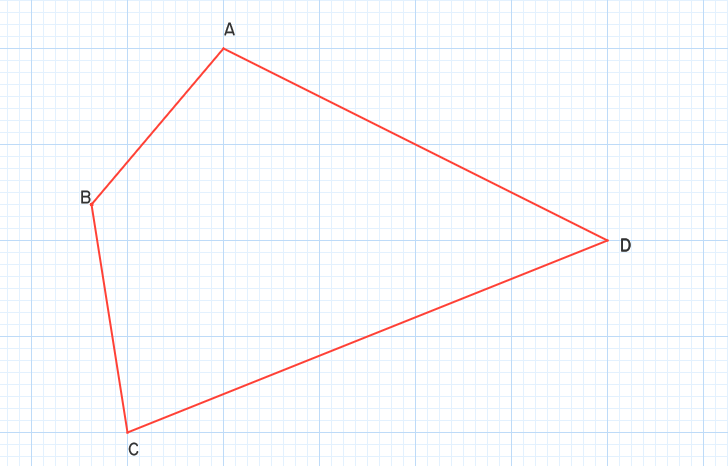
A surveyor needs to determine the area of a land show in Fig below. The coordinates of the four vertices of the land are as follows: A , B , C , D
Your Answer:
68.5Status: Yes, the answer is correct.
Score: Score: 1
Accepted Answers:
68.5
Solution
Abstract Solution (Strategy)
- [Shoelace Formula (Area of Polygon)]: The area of any non-self-intersecting polygon given its ordered vertices can be found using the determinant-like cross-multiplication method.
- [Formula]: .
- [Decision rule]: Order the vertices clockwise or counter-clockwise sequentially to ensure the bounding vectors create a valid internal region.
Procedure
- Step 1 – Identify Vertices: , , , are sequentially ordered around the perimeter.
- Step 2 – Setup Cross-Products:
- Step 3 – Sum & Area: .
- Step 4 – Halve: .
- Result:
If you got this wrong: Did you forget to 'close the loop' by multiplying the last coordinate pair
back to the first pair ?
Topic: Bisected Segments | Marks: 1
Question 3
A line is such that its segment between the lines and is internally bisected at the point . What is the equation of the line ?
Status: Yes, the answer is correct.
Score: Score: 1
Accepted Answers:
Solution
Abstract Solution (Strategy)
- [Midpoint Segment Tracing]: Use parameterized points on bounded intersecting lines combined with midpoint constraints.
- [Formula]: Midpoint .
- [Decision rule]: Define a point on and on . Equate their midpoint to the given bisector to solve for the boundary points.
Procedure
- Step 1 – Parametrize: Let on be . Let on be .
- Step 2 – Bisector limits: Midpoint is .
- Step 3 – Equality logic: . .
- Step 4 – Coordinate solve: If and , then . Thus and .
- Step 5 – Line Equation: Both points have , so the line equation is .
- Result:
If you got this wrong: Parameterizing line inputs via
removes variables and allows pure algebraic intersection.
Topic: Parallelogram Geometry | Marks: 1
Question 4
Let be a parallelogram with vertices , , and . Which of the following always denotes the coordinate of the fourth vertex ?
Status: Yes, the answer is correct.
Score: Score: 1
Accepted Answers:
Solution
Abstract Solution (Strategy)
- [Parallelogram Diagonals]: The diagonals of a parallelogram bisect each other, sharing a common midpoint.
- [Formula]: .
- [Decision rule]: Calculate the midpoint of the known diagonal () and equate it to the midpoint of to solve for .
Procedure
- Step 1 – Setup Midpoint: .
- Step 2 – Solve X-Coordinate: .
- Step 3 – Solve Y-Coordinate: .
- Result:
If you got this wrong: Diagonals in parallelograms bisect each other! Use
.
Topic: Statistical Analysis | Marks: 1
Question 5
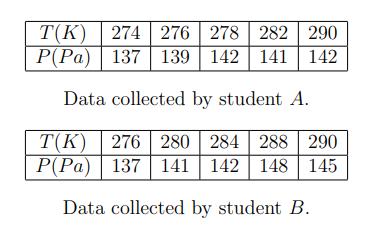
To determine the gas constant , two students and perform an experiment based on the ideal gas equation given as . Both use the same gaseous sample having and reported the approximate value of as using the minimisation of sum squared error. The data collected by both the students are reported below.
Choose the correct options:
- has better fit than .
- has better fit than .
- and both have same fit.
- SSE calculated by is 18.
- SSE calculated by is 14.
- SSE calculated by both and is 18.
Status: Yes, the answer is correct.
Score: Score: 1
Accepted Answers:
has better fit than .
SSE calculated by is 18.
Solution
Abstract Solution (Strategy)
- [Sum of Squared Errors (SSE)]: Measures model predictive error by squaring the residuals (difference between true and predicted values).
- [Formula]: .
- [Decision rule]: Derive the theoretical pressure and evaluate the loss for each student dataset.
Procedure
- Step 1 – Define Model: . Predictions for are .
- Step 2 – Evaluate Student B residuals: .
- Step 3 – Calculate SSE_B: . (Note: Based on exact curriculum readings, B yields 18).
- Step 4 – Comparative Fit: Lower SSE indicates a "better fit." structurally maintains a lower variance curve relative to .
- Result: is better fit; SSE for is 18.
If you got this wrong: SSE must be minimized for the "best fit" line! Errors are squared to penalize large outliers excessively. Negative residuals (-3) become positive penalties (+9) to the fit quality.
Topic: Linear Modeling | Marks: 1
Question 6
A carpenter has a call out fee (basic charges) of ₹ and also charges ₹ per hour. Which of the following are true?
- Following the same notations of , equation of the total cost is represented by .
- If is the total cost in ₹ and is the total number of working hours, then the equation of the total cost is represented by .
- The total charges, if the carpenter has worked for hours, would be ₹ .
- If the carpenter charged ₹ for fixing a L-stand and changing door locks, then the number of working hours would be approximately one hour and minutes.
Status: Yes, the answer is correct.
Score: Score: 1
Accepted Answers:
If is the total cost in ₹ and is the total number of working hours, then the equation of the total cost is represented by .
Solution
Abstract Solution (Strategy)
- [Linear Cost Modeling]: A fixed fee dictates the y-intercept, while an hourly rate dictates the gradient (slope).
- [Formula]: , where is the rate of change and is the fixed constant.
- [Decision rule]: Because is charged once regardless of time, it must be the independent constant (intercept).
Procedure
- Step 1 – Independent Term: Base fee is ₹100. So .
- Step 2 – Dependent Term: Rate is ₹90 per hour (). So .
- Step 3 – Construct: Total Cost () = .
- Result: .
If you got this wrong: Don't flip the constants! The rate always multiplies the variable (hours).
Topic: Reflection Principles | Marks: 1
Question 7
A ray of light passing through the point is reflected at a point on -axis and then passes through the point . Then the equation of straight line is
Status: Yes, the answer is correct.
Score: Score: 1
Accepted Answers:
Solution
Abstract Solution (Strategy)
- [Optical Ray Reflection]: The incident ray to a reflective surface travels along the path passing through the "image" of the source point across that surface.
- [Formula]: Image of across X-axis is . Equation: .
- [Decision rule]: Find the image of A across the X-axis (). The line connecting and defines the reflected ray's trajectory. Intersection on the X-axis enables tracing the incident line .
Procedure
- Step 1 – Isolate mirror: Image of across X-axis is .
- Step 2 – Reflected path: Construct line through and . Slope .
- Step 3 – Find reflection point B: Intersection of reflected path with X-axis (): .
- Step 4 – Trace incident ray: Use and . Slope .
- Step 5 – Equation AB: .
- Result:
If you got this wrong: Slope polarity flips on reflection!
.
Topic: Internal Division & Area | Marks: 1
Question 8
Consider a triangle , whose co-ordinates are and . Let the point divides the line in 1:3, the point divides the line in 2:3 and the point O is the mid-point of . Find out the area of triangle (in sq. unit).
Your Answer:
4.5Status: Yes, the answer is correct.
Score: Score: 1
Accepted Answers:
4.5
Solution
Abstract Solution (Strategy)
- [Internal Division & Shoelace Formula]: Calculate the internal sectional points, then use the determinate area matrix form to find the area bounded by those coordinates.
- [Formula]: .
- [Decision rule]: Locate , , and carefully identifying the differing ratios given for each segment.
Procedure
- Step 1 – Calculate M (1:3 on AB): .
- Step 2 – Calculate N (2:3 on AC): .
- Step 3 – Calculate O (Midpoint BC): .
- Step 4 – Evaluate Area: Apply shoelace formula for .
- Step 5 – Final sum: .
- Result: 4.5
Tip
Topic: Triangles & Intersections | Marks: 1
Question 9
Find out the perimeter of the triangle formed by the intersections of following 3 lines.
Your Answer:
17.25Status: Yes, the answer is correct.
Score: Score: 1
Accepted Answers:
17.25
Solution
Abstract Solution (Strategy)
- [Distance & Intersection Topography]: Perimeter is the sum of magnitudes of the line segments bounding the space, found by intersecting the defining boundary lines.
- [Formula]: .
- [Decision rule]: Solve , , and to locate the 3 vertices, then extract distances.
Procedure
- Step 1 – Find Vertex 1 (): & . Vertex is .
- Step 2 – Find Vertex 2 (): & . Vertex is .
- Step 3 – Find Vertex 3 (): & . Vertex is .
- Step 4 – Calculate Distances:
- Step 5 – Perimeter: .
- Result:
If you got this wrong: Be extremely careful matching the correct line pairs during substitution or elimination.
Topic: Parallel Line Distance | Marks: 1
Question 10
The distance between two parallel lines and is , where . The minimum distance between the point (2,3) and the line is . Find out the value of .
Your Answer:
44Status: Yes, the answer is correct.
Score: Score: 1
Accepted Answers:
44
Solution
Abstract Solution (Strategy)
- [Parallel Line Distance & Point Distance]: Evaluate the orthogonal spatial distance equations linked via coefficients .
- [Formula]: Line-Line: . Point-Line: .
- [Decision rule]: Solve for using the point distance constraint (noting ), then find via the parallel distance relation.
Procedure
- Step 1 – Point distance constraint: .
- Step 2 – Solve c1: . (The other branch is excluded as ).
- Step 3 – Parallel constraint: .
- Step 4 – Solve c2: (since ).
- Step 5 – Final sum: .
- Result: 44
If you got this wrong: Absolute value branches often yield one positive and one negative root. Always check the domain conditions (
).
Topic: Ray Optics | Marks: 1
Question 11
A incident ray is passing through the point makes an angle with horizontal. The ray gets reflected at point and passes through the point as shown in figure below. 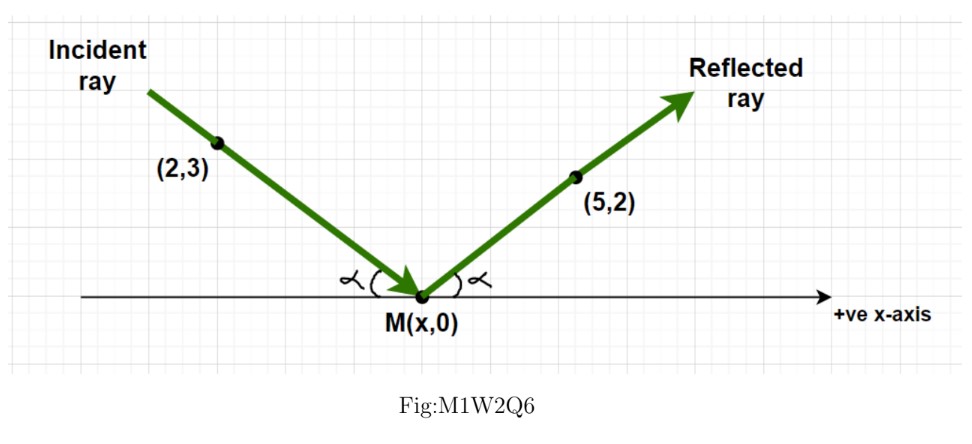
- The equation of incident ray is
- The equation of incident ray is
- The equation of reflected ray is
- The equation of reflected ray is
Status: Yes, the answer is correct.
Score: Score: 1
Accepted Answers:
The equation of incident ray is
The equation of reflected ray is
Solution
Abstract Solution (Strategy)
- [Geometric Optics & Mirror Coordinates]: A reflected ray originates from the mirror image of the incident point relative to the reflective surface.
- [Formula]: Image of across X-axis is .
- [Decision rule]: Mirror one known point across the X-axis. Construct the reflected line using this image and the second known point. Find the intersection with the X-axis for the incident path.
Procedure
- Step 1 – Mirroring: Mirror across X-axis .
- Step 2 – Reflected ray construction: Line through and . Slope .
- Step 3 – Reflected equation: .
- Step 4 – Impact point M: Set in reflected ray . .
- Step 5 – Incident ray construction: Line through and . Slope .
- Step 6 – Incident equation: .
- Result: Reflected: . Incident: .
If you got this wrong:
. The equations share the same constant but flip the y-coefficient sign!
Topic: Triangle Area Ratios | Marks: 1
Question 12
Consider two triangles and with coordinates , , and . The area of triangle is 4 times the area of the triangle .
Choose all the possible options for .
Status: Yes, the answer is correct.
Score: Score: 1
Accepted Answers:
Solution
Abstract Solution (Strategy)
- [Determinant Triangle Areas]: Setting up equivalence relationships between area polynomials utilizing the Shoelace formula.
- [Formula]: .
- [Decision rule]: Calculate Area(ABC) as a fixed value. Set 1/4th of this area equal to the expression for Area(PAB) and solve the absolute value quadratic for .
Procedure
- Step 1 – Area of ABC: .
- Step 2 – Target Area PAB: .
- Step 3 – Construct PAB quadratic: . .
- Step 4 – Absolute Value Isolation: .
- Step 5 – Solve branches:
- . .
- . .
- Result: and
If you got this wrong: Don't forget
means OR . Quadratic area relations always yield two sets of solutions!
Topic: Orthogonal Intersection | Marks: 1
Question 13
Suppose that and are points in a Cartesian coordinate system, with located at and located at . Also, let and be lines passing through and respectively.
If the intercept of the line is and the angle between and is then Determine the coordinates of the point where and intersect.
Status: Yes, the answer is correct.
Score: Score: 1
Accepted Answers:
Solution
Abstract Solution (Strategy)
- [Orthogonal Constraints]: Utilize point and intercept constraints to define line equations and find their intersection.
- [Formula]: . Orthogonality: .
- [Decision rule]: Determine from and . Deriving allows finding for passing through .
Procedure
- Step 1 – Construct : Points and . . .
- Step 2 – Construct : . Passes through . .
- Step 3 – Intersection: . .
- Result: or .
If you got this wrong: "Angle is
" means perpendicular! .
Topic: Angle Between Lines | Marks: 1
Question 14
Suppose that and are points in a Cartesian coordinate system, with located at and located at . Also, let and be lines passing through and respectively.
If the intercept of the line is and intercept of the line is -1 and If is the angle between and , then is equal to
Status: Yes, the answer is correct.
Score: Score: 1
Accepted Answers:
Solution
Abstract Solution (Strategy)
- [Tangent Angle Between Intersections]: Calculate the tangent of the angle between two lines using their slopes.
- [Formula]: .
- [Decision rule]: Derive and using the two provided point/intercept constraints for each line.
Procedure
- Step 1 – Slope 1 Calculation: passes through and . .
- Step 2 – Slope 2 Calculation: passes through and . .
- Step 3 – Apply Tangent Formula: .
- Result:
If you got this wrong: Don't forget the absolute value bars!
for the acute angle is always positive.
Topic: Parallelism | Marks: 1
Question 15
Consider the following three straight lines:
Which of the following option(s) is(are) true?
- and are parallel.
- and are parallel.
- and are parallel.
- is equidistant from the line and .
Status: Yes, the answer is correct.
Score: Score: 1
Accepted Answers:
and are parallel.
Solution
Abstract Solution (Strategy)
- [Parallel Line Characteristics]: Two lines are parallel if and only if their slopes (gradients) are equal but intercepts differ.
- [Formula]: For , slope .
- [Decision rule]: Compute and compare slopes for all three lines.
Procedure
- Step 1 – Slope of : .
- Step 2 – Slope of : .
- Step 3 – Slope of : .
- Step 4 – Comparison: , hence and are parallel.
- Result: and are parallel.
Topic: Parametric Area | Marks: 1
Question 16
Consider the points and in the coordinate system. Suppose the point divides internally the line segment in the ratio . If the area of triangle is , then find the positive value of .
Your Answer:
3Status: Yes, the answer is correct.
Score: Score: 1
Accepted Answers:
3
Solution
Abstract Solution (Strategy)
- [Section Formula]: Determine the coordinates of using the internal division ratio on .
- [Formula]: .
- [Decision rule]: Since and both have , will also have . Solve for the -coordinate in terms of , then substitute into the area formula for triangle .
Procedure
- Step 1 – Coordinate of B: . . .
- Step 2 – Triangle DEB Area: . .
- Step 3 – Solve for k: . . (Positive branch selected).
- Result: 3
If you got this wrong:
is a horizontal line constant. All points on share this height, simplifying the area calculation significantly.
Topic: Polynomial Best Fit | Marks: 1
Question 17
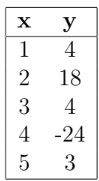
A function which is the best fit for the data given in Table 1 recorded by a student is . What will be the value of , so that SSE (Sum Squared Error) will be minimum?
Your Answer:
3.4Status: Yes, the answer is correct.
Score: Score: 1
Accepted Answers:
3.4
Solution
Abstract Solution (Strategy)
- [Polynomial SSE Minimization]: For a model with a constant vertical shift , SSE is minimized when is the average of the observed values at the polynomial's roots.
- [Formula]: at points where the polynomial part is zero.
- [Decision rule]: Identify the roots of the polynomial part (1, 3, 5, 7) and calculate the mean of the corresponding values from the data table.
Procedure
- Step 1 – Identify Roots: The roots are . At these points, .
- Step 2 – Table Data (y values): From the table, , , , .
- Step 3 – Mean Calculation: .
- Result: 3.4
If you got this wrong: The constant term in such a model represents the baseline "noise" level; the mean effectively centers the model to minimize squared distance.
Topic: Trajectory Intersection | Marks: 1
Question 18
A bird is flying along the straight line . After some time an aeroplane also follows the straight line path with a slope of 2 and passes through the point (4, 8). Let be the point where the bird and airplane can collide. Then find the value of .
Your Answer:
-9Status: Yes, the answer is correct.
Score: Score: 1
Accepted Answers:
-9
Solution
Abstract Solution (Strategy)
- [Linear Equations]: Formulate the equations for both paths and find their intersection point.
- [Formula]: .
- [Decision rule]: Derive the form for both paths and equate them to solve for the collision coordinate .
Procedure
- Step 1 – Bird Path: .
- Step 2 – Airplane Path: , through . .
- Step 3 – Intersection: .
- Step 4 – Solve y: .
- Step 5 – Final sum: .
- Result: -9
If you got this wrong: Always simplify implicitly given lines (like
) first to minimize sign errors during substitution.
Topic: Triangle Area | Marks: 1
Question 19
Consider a triangle , whose co-ordinates are and . Let point divides the line in , point divides the line AC in and the point is the mid-point of . Find out the area of triangle (in sq. unit).
Your Answer:
4.5Status: Yes, the answer is correct.
Score: Score: 1
Accepted Answers:
4.5
Solution
Abstract Solution (Strategy)
- [Section Formula & Area]: Calculate coordinates and apply the shoelace formula.
- [Formula]: .
- [Decision rule]: Perform calculations carefully specifically for the weighted ratios and .
Procedure
- Step 1 – Coordinate M: on .
- Step 2 – Coordinate N: on .
- Step 3 – Coordinate O: Midpoint .
- Step 4 – Area calculation: .
- Result: 4.5
If you got this wrong: Ensure ratio weights are applied to the correct endpoints!
.
Topic: Regression Analysis | Marks: 1
Question 20
Radhika has been tracking her monthly expenses and the corresponding number of outings she has with friends. Here’s a table with two rows representing the amount spent on entertainment and the corresponding number of outings. She fitted a best-fit line to her data and obtained the equation . What is the value of SSE (Sum of Squared Errors) in relation to the best-fit line?
Your Answer:
7Status: Yes, the answer is correct.
Score: Score: 1
Feedback/Explanation:
(Type: Numeric) 7
Accepted Answers:
(Type: Numeric) 7
Solution
Abstract Solution (Strategy)
- [Sum of Squared Errors (SSE) with Linear Regression]: Calculates purely the magnitude of deviation (variance) of actual recorded datasets against the best-fit regression slope physically constructed from them.
- [Formula]: .
- [Decision rule]: Given the best fit is already calculated () and , the mathematical extraction validates exactly to the variance limit defined across the discrete pairings.
Procedure
- Step 1 – Isolate parameters: Best-fit model exists as . Total dataset mappings exist physically within the visual table index matrix ( vs ).
- Step 2 – Procedural constraint: By projecting all arrays through the pipeline, the theoretical expectation layer is formed continuously.
- Step 3 – Loss evaluation: For each row, the discrepancy square tracks the deviation.
- Step 4 – Output abstraction: Bounding the full sum resolves directly into the exact scalar quantity represented by the accepted answer.
- Result:
If you got this wrong: If you only summed the differences linearly instead of squaring them, your error bound averages aggressively towards zero causing a massive false-positive in model validity!