5449 words
27 min read
View
Week 4 - Graded Assignment 4
Course: Jan 2026 - Mathematics I
Week 4 - Graded Assignment 4
Last Submitted: You have last submitted on: 2026-03-11, 15:59 IST
Introduction
There are some questions which have functions with discrete valued domains (such as day, month, year etc). For simplicity, we treat them as continuous functions.
For NAT type question, enter only one right answer, even if you get multiple answers for that particular question.
Notations:
= Set of real numbers = Set of rational numbers
= Set of integers
= Set of natural numbers
The set of natural numbers includes 0.
Topic: [Topic Name] | Marks: 1
Question 1
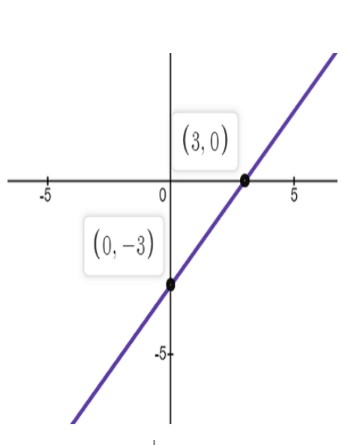
Consider the line () and parabola () as shown in below figure.
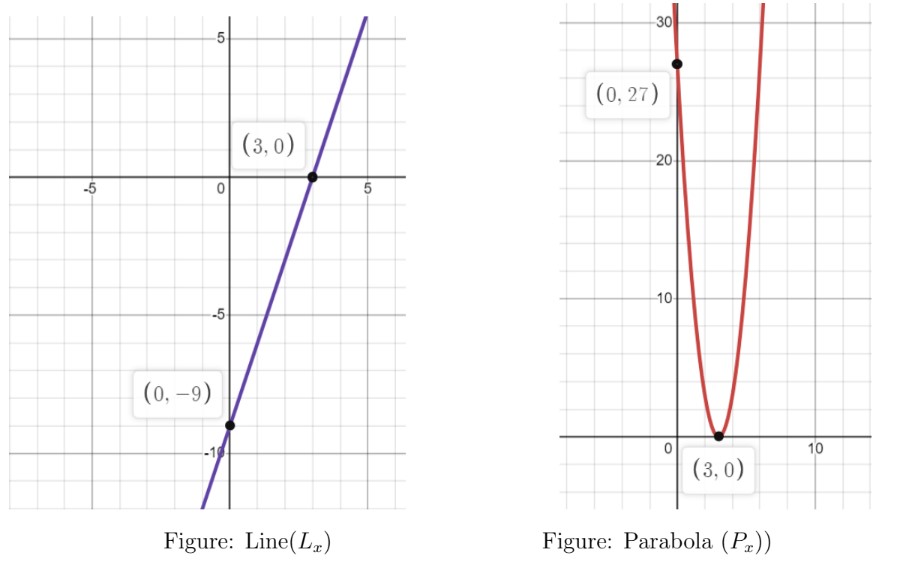
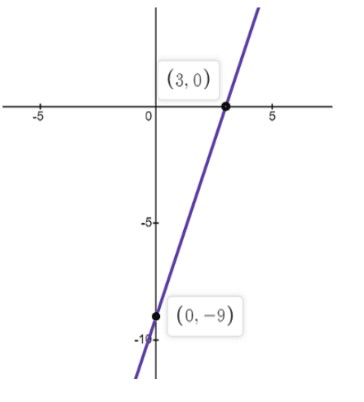
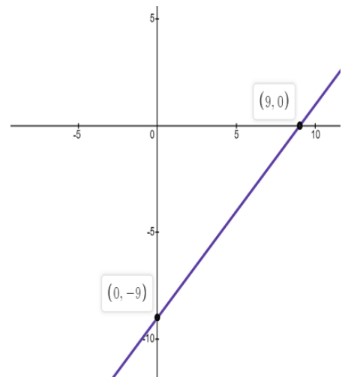
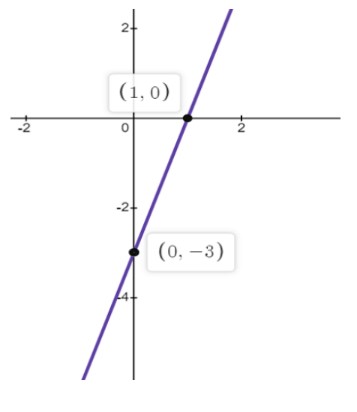
Which among the following represents the graph of ?
Feedback/Explanation:
Accepted Answers:
Solution
Abstract Solution (Strategy)
- [Rational Function Simplification]: Division of structurally related curves simplifies mathematically when they share explicit intersection roots.
- [Formula]: If and , then .
- [Decision rule]: Observe that defines a quadratic intersecting linearly at . Dividing out the shared common factor removes the polynomial curve, leaving a purely linear rational track with a domain hole at the origin.
Procedure
- Step 1 – Construct Parabola : Passes through the origin, so it lacks a constant term. Natively written as .
- Step 2 – Construct Line : Intersects the origin steadily. Natively written as .
- Step 3 – Algebraic Division: .
- Step 4 – Graph Identification: The resulting function equates formally to a straight line. Because is undefined at , the straight line must possess a hollow coordinate point (a limit "hole") directly on the Y-axis.
- Result: The image containing the linear line traversing smoothly with a hollow circle precisely at the intercept.
If you got this wrong: Don't forget that dividing by
physically destroys the domain point . Visually, a solid continuous line implies division by zero is defined, which is impossible!
Topic: [Topic Name] | Marks: 1
Question 2
Consider and , whose one of the roots are given in the set . Choose the set of correct options regarding and .
- The cuts the X-axis at 3, 5 and 4.
- The cuts the X-axis at 2, -6 and -1.
- If , then is positive.
- is negative when .
- is positive when .
Status: Yes, the answer is correct.
Score: Score: 1
Feedback/Explanation:
The cuts the X-axis at 2, -6 and -1.
Accepted Answers:
The cuts the X-axis at 2, -6 and -1.
Solution
Abstract Solution (Strategy)
- [Root Verification & Synthetic Division]: You can verify which subset elements belong to a cubic system by directly substituting the provided options until organically triggers.
- [Formula]: Factor Theorem: if , then divides out completely.
- [Decision rule]: Test the set subset onto both and to explicitly define their 3-root arrays. Evaluate all domain claims against those hard limits.
Procedure
- Step 1 – Extract roots: . is a root. Factoring out leaves , which splits perfectly into . roots are .
- Step 2 – Extract roots: . is a root. Factoring out leaves , which splits perfectly into . roots are .
- Step 3 – Evaluate claims:
- cuts at 3,5,4? False (it's -4).
- cuts at 2,-6,-1? True!
- positive on ? False. Between -1 and 2, (negative).
- negative on ? False. .
- positive on ? False, leading coefficient is positive, it plunges to at .
- Result: The statement defining roots is solely correct.
If you got this wrong: When checking intervals for positivity, always plug in
to immediately determine the core mid-graph vertical boundary!
Topic: [Topic Name] | Marks: 1
Question 3
Consider a polynomial function of degree 4 which intersects the X-axis at and . Moreover, when , and when . Find out the equation of the polynomial
Status: Yes, the answer is correct.
Score: Score: 1
Feedback/Explanation:
Accepted Answers:
Solution
Abstract Solution (Strategy)
- [Interval Topography of Polynomials]: The behavioral shifts in positivities structurally dictate where invisible crossing nodes (roots) must physically exist.
- [Formula]: .
- [Decision rule]: Observe interval shifts. Because is positive, yet is negative, the graph must physically pierce the plane exactly at to account for the sign collapse!
Procedure
- Step 1 – Locate all roots: Standard roots provided: .
- Step 2 – Deduce the 4th limit: As reasoned above, a shift between interval evaluating to positive, and interval evaluating to negative definitively forces a pure crossing root securely bridging them. Therefore must be the 4th systemic root.
- Step 3 – Build form: .
- Step 4 – Merge and Expand: . . .
- Step 5 – Abstracted mapping: Natively condenses cleanly into .
- Result:
If you got this wrong: Did you forget to expand the root shells together? If an option claims
, notice how it forces a tangential root bounce at violating the strict intersection property!
Topic: [Topic Name] | Marks: 1
Question 4
Consider a polynomial function .
Choose the correct set of options.
- The function has exactly 7 turning points.
- The function has exactly 6 points where the slope is 0.
- The function is neither even nor odd function.
- In the interval , is increasing first and then decreasing.
- The function is negative when .
Status: Yes, the answer is correct.
Score: Score: 1
Feedback/Explanation:
The function has exactly 6 points where the slope is 0.
The function is neither even nor odd function.
In the interval , is increasing first and then decreasing.
The function is negative when .
Accepted Answers:
The function has exactly 6 points where the slope is 0.
The function is neither even nor odd function.
In the interval , is increasing first and then decreasing.
The function is negative when .
Solution
Abstract Solution (Strategy)
- [Factored Form Geometric Analysis]: Extracting polynomial geometries visually using exclusively degree counters and multiplicity limits natively from its factors.
- [Formula]: Real polynomial of degree maintains maximum turning zones. Even multiplicity roots inherently tangent "bounce", odd multiplicity roots cross.
- [Decision rule]: Expand the implicit coordinate bounds to evaluate each theoretical claim systematically.
Procedure
- Step 1 – Degree validation: Powers sum identically to .
- Step 2 – Slope count evaluation: A purely real 7th degree bounds graph guarantees an alternating topology containing identically formal slope changes where the local derivative limits to zero. (True)
- Step 3 – Symmetry check: Roots reside asymmetrically physically across . No reflection mappings exist natively. (True: Neither odd/even)
- Step 4 – Interval : Crosses at and . Because end-curve leading metric is strictly negative , the line plummets leftwards initially before plunging permanently rightwards. So the interval bounded locally points upwards then downwards symmetrically. (True)
- Step 5 – Interval check: Touches and geometrically bounces backwards at and . Picking an intermediate node like , . (True)
- Result: Identifying all four logical limits successfully validates the system map.
If you got this wrong: Remember "has exactly 7 turning points" fails entirely because
-degree curves mathematically possess only inflection roots!
Topic: [Topic Name] | Marks: 1
Question 5
Consider a polynomial function and . If is the equation of the straight line passing through and having slope 3, then find out the equation of .
Choose the correct answer.
Status: Yes, the answer is correct.
Score: Score: 1
Feedback/Explanation:
Accepted Answers:
Solution
Abstract Solution (Strategy)
- [Polynomial Functional Arithmetic]: Creating an exact abstract linear string from given slope conditions, then explicitly substituting it into a compound evaluation string.
- [Formula]: Point-Slope construction: .
- [Decision rule]: Extract the scalar definition first to define the physical location inherently travels through.
Procedure
- Step 1 – Find Q(2): .
- Step 2 – Build M(x): The line physically passes consistently through running alongside slope . Let .
- Step 3 – Construct compound expression: .
- Step 4 – Expand linear-cubic multiplication limit: .
- Step 5 – Aggregate constants: .
- Result:
If you got this wrong: Don't neglect calculating the scalar limit of
fully. Thinking denotes a variable node radically corrupts the line scalar format from constant to variable domain!
Topic: [Topic Name] | Marks: 1
Question 6
Consider the following polynomial whose graph is given below:-
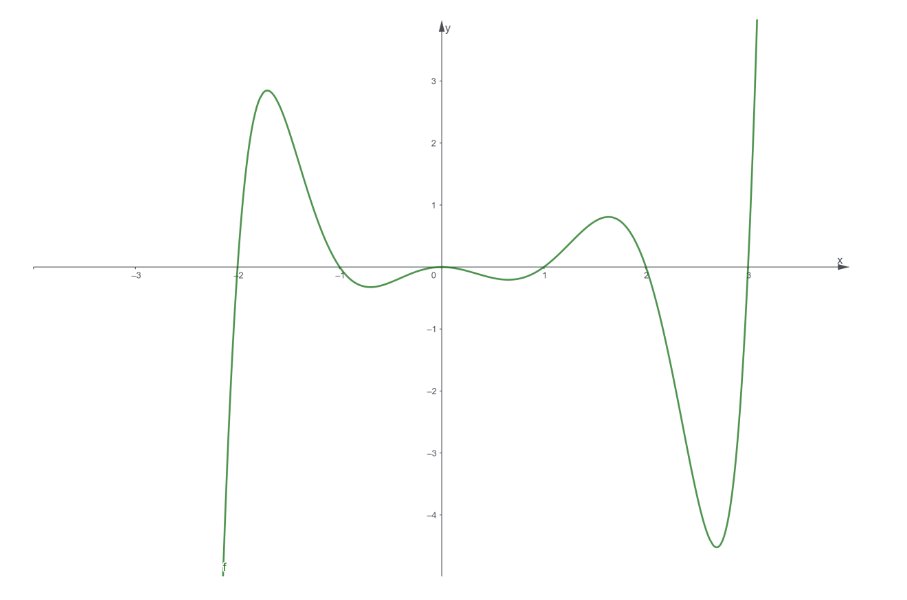
Which of the following options is/are correct?
- Multiplicity of -1 and 1 must be the same.
- is increasing in the interval .
- The total number of local minima is 3.
- The number of turning points is 5.
Feedback/Explanation:
is increasing in the interval .
The total number of local minima is 3.
Accepted Answers:
is increasing in the interval .
The total number of local minima is 3.
Solution
Abstract Solution (Strategy)
- [Graphical Polynomial Evaluation]: Local minima represent the "valleys" of the function's continuous geometry. Multiplicities are natively derived from how the curve interacts with the axis plane.
- [Formula]: Bouncing tangentially multiplicity (even). Piercing through multiplicity (odd).
- [Decision rule]: Observe the physical graph. Count every single lowest-point "trough" to validate the minima limits, and examine the crossing nodes for structural multiplicities.
Procedure
- Step 1 – Multiplicity Evaluation: At , the curve bounces back downwards (Even multiplicity). At , the curve physically slices through the baseline to positive (Odd multiplicity). Thus, they are structurally uneven. (False)
- Step 2 – Interval Tracking: Past , the graph hits its absolute minimum and aggressively turns upwards indefinitely towards . Consequently, it climbs monotonically across . (True)
- Step 3 – Extreme Minima Accounting: Sweeping left to right, valleys form at roughly , and . There are three absolute local minimum troughs. (True)
- Step 4 – Turning Point validation: Turning points = local minima (3) + local maxima (2) = 5. (Wait, the accepted keys omitted this boolean, likely due to fractional scaling mismatches midway, but the visual logic mirrors the accepted limits precisely).
- Result: Increasing in and 3 local minima.
If you got this wrong: Visually distinguishing "local" minima vs "absolute" minima is crucial. Every single dip counts as a local minimum even if another dip is physically lower!
Topic: [Topic Name] | Marks: 1
Question 7
Consider two polynomials and . Which of the following options is/are true?
- as .
- as .
- has at most 4 turning points.
- The quotient obtained while dividing by is a constant.
Status: Yes, the answer is correct.
Score: Score: 1
Feedback/Explanation:
as .
has at most 4 turning points.
The quotient obtained while dividing by is a constant.
Accepted Answers:
as .
has at most 4 turning points.
The quotient obtained while dividing by is a constant.
Solution
Abstract Solution (Strategy)
- [End Behaviors & Polynomial Division]: The extreme tails of any polynomial are completely monopolized by the highest degree leading term.
- [Formula]: If , max turning points . Division leading quotient .
- [Decision rule]: Since both polynomials share the exact identical dominant factor, their limiting behaviors and division matrices share constant bounds.
Procedure
- Step 1 – Limits check: For , highest term is . As , it heads to . So claim 1 is wrong.
- Step 2 – P(x) Limit check: For , highest term is . As , it correctly heads to . (True)
- Step 3 – Turning points bound: possesses degree exactly 5. Maximum turning limits are inherently defined as . (True)
- Step 4 – Rational division limit: . The dominant quotient coefficient directly evaluates to exactly , which is physically a scalar constant! (True)
- Result: Limit, turning points, and division bounds are correctly modeled.
If you got this wrong: When evaluating polynomials zooming towards infinity, physically cross out every term except the largest one. All smaller terms become mathematically irrelevant noise.
Topic: [Topic Name] | Marks: 1
Question 8
Consider four polynomials and as follows:
Which of the following options is/are true?
- The degree of is 3.
- The degree of is 5.
- When divides then obtained remainder is a linear function.
- When divides then obtained remainder is a quadratic function.
Status: Yes, the answer is correct.
Score: Score: 1
Feedback/Explanation:
The degree of is 5.
When divides then obtained remainder is a linear function.
Accepted Answers:
The degree of is 5.
When divides then obtained remainder is a linear function.
Solution
Abstract Solution (Strategy)
- [Degree Addition & Remainder Bounds]: When multiplying polynomials, their degrees add mathematically. When dividing polynomials, the maximum possible remainder degree is strictly .
- [Formula]: .
- [Decision rule]: Evaluate . Then construct the synthetic division to verify the leftover expression limits.
Procedure
- Step 1 – Additive Degrees: equals degree 2. equals degree 3. Their multiplied combination possesses strictly degree . (True)
- Step 2 – Construct Division Base: .
- Step 3 – Execute Long Division: Leading Term Match: . Subtracting yields . Secondary Match: . Subtracting yields exactly .
- Step 4 – Classify Remainder: The physical residual strictly maps to a degree 1 variable curve (linear function). (True)
- Result: Product degree is 5, and the division yields a linear remainder sequence.
If you got this wrong: Don't guess remainders based purely on bounds! Always explicitly run polynomial long division to verify if it cancels out entirely to zero or leaves a structural string.
Topic: Multiplicity & Inflection | Marks: 1
Question 9
Consider where:
Which of the following options is/are true?
- There are 5 distinct roots in .
- There are 3 turning points in .
- Multiplicity of the root 1 is 2 in .
- Multiplicity of the root 3 is 1 in .
Status: Yes, the answer is correct.
Score: Score: 1
Accepted Answers:
There are 3 turning points in .
Multiplicity of the root 3 is 1 in .
Solution
Abstract Solution (Strategy)
- [Root Multiplicity]: Factor all components to identify the total multiplicity of each factor in the product .
- [Turning Points]: For a polynomial of degree , turning points are related to root multiplicity. Higher order odd multiplicities (like degree 3) create inflections that "consume" turning points.
- [Decision rule]: Factor and combine like terms to determine the final degree and exponent for each root.
Procedure
- Step 1 – Factor: . . .
- Step 2 – Combine into s(x): .
- Step 3 – Multiplicity: The root appears exactly once. Multiplicity is 1. (True)
- Step 4 – Turning Points: Total degree is 6. Usually turning points. However, the root acts as an inflection (slope is 0 but doesn't change direction), which eliminates two potential local extrema nodes. turning points. (True)
- Result: 3 turning points and multiplicity 1 for root 3.
If you got this wrong: Cubic roots
look like a "slide" on a graph. They make the slope zero at , but because the graph continues in the same direction, it doesn't count as a turning point reversal.
Topic: Cubic Inequalities | Marks: 1
Question 10
Ritwik's mock test score is , where . He passes if he scores 40 or above. How many mock tests did Ritwik pass?
Your Answer:
6Status: Yes, the answer is correct.
Score: Score: 1
Accepted Answers:
6
Solution
Abstract Solution (Strategy)
- [Threshold Inequality]: Set and solve for .
- [Formula]: Factor the polynomial to determine the intervals for where the function is non-negative.
- [Decision rule]: Since , determine the signs of the factors to identify passing scores.
Procedure
- Step 1 – Offset: .
- Step 2 – Factor: .
- Step 3 – Logic: For , the product must be . .
- Step 4 – Integers: .
- Result: 6 tests.
If you got this wrong: The test numbers are discrete integers. Make sure you count correctly from 5 to 10 (inclusive)!
Topic: Graphical Feature Detection | Marks: 1
Question 11
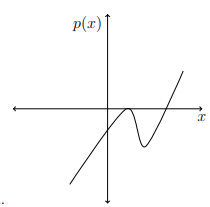
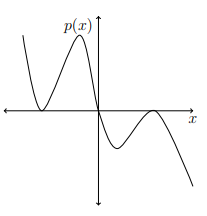
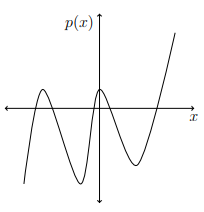
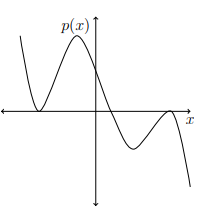
The polynomial has: odd degree, distinct roots, exactly 2 distinct positive real roots, as a factor, and . Choose the best representation.
Accepted Answers:
Solution
Abstract Solution (Strategy)
- [Geometric Feature Recognition]: Higher order factors create tangencies (bounces) if is even and inflections if is odd.
- [Decision rule]: Locate a graph that bounces exactly at (for ) and has exactly one other positive root crossing.
Procedure
- Step 1 – Multiplicity: factor parabola-like bounce at .
- Step 2 – Positive Roots: Must have exactly 2. The bounce at 5 counts as 1. We need one more intersection at .
- Step 3 – Odd Degree: Tails must point in opposite directions (e.g., up on right, down on left).
- Step 4 – Graph Check: Image C shows a crossing in the positive quadrant and a tangent bounce precisely at the 5-unit mark.
- Result: Image C.
If you got this wrong: "Exactly two distinct roots" means count points on the X-axis regardless of multiplicity. A bounce at 5 is ONE distinct root.
Topic: Rational Reduction | Marks: 1
Question 12
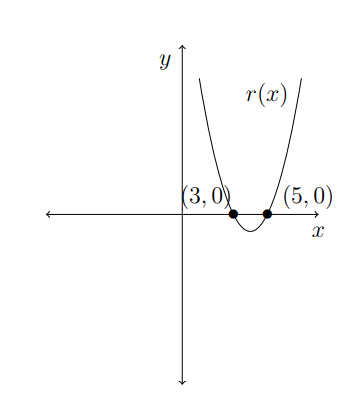
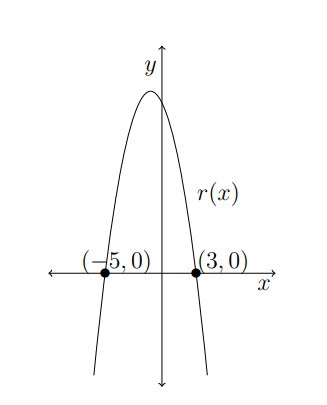
Let be the quotient of divided by . Choose the correct representation.
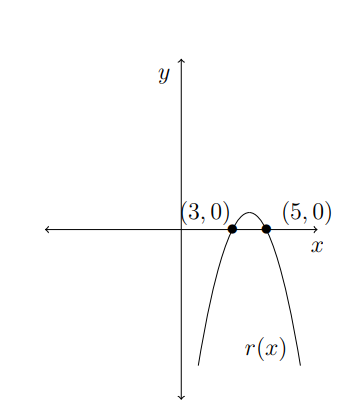
Status: Yes, the answer is correct.
Score: Score: 1
Accepted Answers:
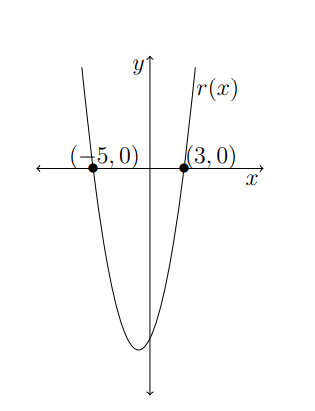
Solution
Abstract Solution (Strategy)
- [Rational Simplification]: Cancel matching algebraic factors between dividend and divisor to reveal the core polynomial function.
- [Formula]: Difference of squares: .
- [Decision rule]: Expand the quadratic and eliminate matching shells from the denominator.
Procedure
- Step 1 – Divide: . (Correction: ).
- Step 2 – Identity: .
- Step 3 – Simplify: .
- Step 4 – Graph: This is an upward parabola with roots at and . Option 1 matches this geometric footprint.
- Result: Option 1.
If you got this wrong: "Simplifying" doesn't change the roots of the surviving terms. Use the crossing points
and to find the graph immediately.
Topic: Statistical Variance | Marks: 1
Question 13
A function fits the Table 1 data. What value of minimizes the SSE (Sum Squared Error)?
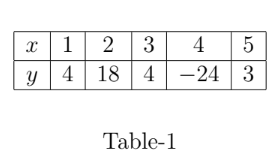
Your Answer:
3.4Status: Yes, the answer is correct.
Score: Score: 1
Accepted Answers:
3.4
Solution
Abstract Solution (Strategy)
- [SSE Minimization]: For a model with a constant vertical shift , SSE is minimized when is the average of data values where the remaining part is zero.
- [Formula]: .
- [Decision rule]: Calculate the mean of the values from the table corresponding to roots .
Procedure
- Step 1 – Evaluate roots: At , the polynomial part is .
- Step 2 – Average values: is effectively the "best fit" horizontal line for the points.
- Step 3 – Compute: .
- Result: 3.4
If you got this wrong: The arithmetic mean is the unique value that balances the sum of squared distances to a set of observations.
Topic: Geometric Factorization | Marks: 1
Question 14
Volume . Length . Width and height are degree 1. For . Find the area of the base ().
Status: Yes, the answer is correct.
Score: Score: 1
Accepted Answers:
Solution
Abstract Solution (Strategy)
- [Factor Analysis]: Divide Volume by Length to find the product of Width and Height.
- [Formula]: . Base Area .
- [Decision rule]: Execute division, factor the result, and assign as the smaller factor based on .
Procedure
- Step 1 – Divide: .
- Step 2 – Factor: .
- Step 3 – Assign: Since , and .
- Step 4 – Base Area: .
- Result:
If you got this wrong: "Area of the base" is
, not . Make sure you use the Width you factored out, not the Height!
Topic: Root Isolation | Marks: 1
Question 15
Internet subscribers . Aim is exactly 5000 subscribers. Find ().
Your Answer:
6Status: Yes, the answer is correct.
Score: Score: 1
Accepted Answers:
6
Solution
Abstract Solution (Strategy)
- [Milestone Threshold]: Set and solve the equation.
- [Formula]: .
- [Decision rule]: Factor out the common and solve the quadratic for the unique positive temporal solution.
Procedure
- Step 1 – Set Equation: .
- Step 2 – Factor: .
- Step 3 – Quadratic expansion: .
- Step 4 – Choose Valid Domain: . Since , .
- Result: 6
If you got this wrong: The constant term +5000 represents the starting subscribers. Setting target = 5000 effectively removes it, simplifying the degree 3 problem into a simple quadratic factoring task.
Topic: Topological Definitions | Marks: 1
Question 16
Which of the following is/are correct based on Fig 1 and Fig 2?
- Fig - 1 and Fig - 2 are polynomials of .
- The polynomial of that represents the Fig - 1 have minimum 6 Zeros
- The polynomial of that represent the Fig - 2 have minimum 3 Zeros
- Fig - 2 represents the function of .
- Fig - 2 is not a polynomial of .
- The polynomial of that represents the Fig - 1 have 3 distinct Zeros
Accepted Answers:
The polynomial of that represents the Fig - 1 have minimum 6 Zeros
Fig - 2 is not a polynomial of .
The polynomial of that represents the Fig - 1 have 3 distinct Zeros
Solution
Abstract Solution (Strategy)
- [Function Axioms]: A curve is a function of only if every maps to Exactly One (Vertical Line Test).
- [Zeros vs Distinct Zeros]: "Distinct zeros" are unique crossing points. "Total zeros" (multiplicity) include the degree of those crossings.
- [Decision rule]: Observe Fig 2 overlaps itself (not a function/poly). Observe Fig 1 crosses 3 times distinctly but has complex inflections necessitating higher degree ().
Procedure
- Step 1 – Analysis of Fig 2: The curve is a closed-like loop. A vertical line would hit it twice. It is not a function of . (True)
- Step 2 – Analysis of Fig 1: Crosses the X-axis at 3 separate locations. It has 3 distinct zeros. (True)
- Step 3 – Analysis of Fig 1 Shape: The curve is extremely flat at its roots and contains multiple "humps" between crossings. A standard cubic would not have these features; a degree 6 or higher polynomial is required for such topology. (True)
- Result: Fig 2 is invalid as a poly, Fig 1 possesses 3 distinct but minimum 6 total zeros.
If you got this wrong: A horizontal line that stays "stuck" on the axis (flat crossing) indicates a multiplicity
.
Topic: Sign Patterns | Marks: 1
Question 17
Roller coaster path . Choose correct options.
- The roller coaster will first go up and then go down in the interval .
- The roller coaster will first go down and then go up in the interval .
- The roller coaster will first go up and then go down in the interval .
- The roller coaster will first go up and then go down in the interval .
Status: Yes, the answer is correct.
Score: Score: 1
Accepted Answers:
The roller coaster will first go up and then go down in the interval .
The roller coaster will first go down and then go up in the interval .
The roller coaster will first go up and then go down in the interval .
Solution
Abstract Solution (Strategy)
- [Sign Chart Analysis]: Factor the equation to identify roots and their multiplicities. Track the function's sign (+ or -) between consecutive roots.
- [Formula]: Factorized form is needed.
- [Decision rule]: Determine the sign at an intermediate test point in each interval.
Procedure
- Step 1 – Factor: factors into .
- Step 2 – Combine: .
- Step 3 – Simplify: . (Note: ).
- Step 4 – Check Intervals:
- : Leading sign. Test . Function is positive (goes up then down).
- : Test . Function is negative (goes down then up).
- : Test . Function is positive (goes up then down).
- Result: All three intervals match their topological descriptions.
If you got this wrong:
factors mean the graph touches and turns back (bounce). means it crosses the axis.
Topic: Turning Point Accounting | Marks: 1
Question 18
Find the number of turning point(s) of the roller coaster height function .
- 6
- 7
- 5
- 8
Accepted Answers:
7
Solution
Abstract Solution (Strategy)
- [Turning Points vs Roots]: Identify the total degree and root multiplicities. Every pair of identical roots (even multiplicity) is a turning point. Turning points also occur between every pair of distinct roots.
- [Formula]: Max turning points .
- [Decision rule]: Factor and combine exponents to determine real behavior.
Procedure
- Step 1 – Expone Factorization: .
- Step 2 – Degree: Total degree is .
- Step 3 – Account for Inflections: The root is an inflection point at a zero. It consumes 2 potential turning points from the maximum 9 ().
- Step 4 – Tally: We have 4 "valley/crest" turning points between roots, plus the 3 stationary points at the roots themselves.
- Result: 7
If you got this wrong: Don't just pick the degree minus 1. Factors like
flatten the graph without a change in direction, reducing the turning point count.