945 words
5 min read
Visual companion
View
Revision summary
What this note is really saying
Short form
# Week 10 - Graded Assignment 10 > **Course:** Jan 2026 - Mathematics I > Week 10 - Graded Assignment 10 > **Last Submitted:** You have last submitted on: 2026-04-22, 19:07 IST --- ## Introduction [Click here to download the PDF version of the Questions](https://drive.google.com/file/d/1-SkYwhDmGScXJzZ0T5Hn8Blw-HWnL...

Visual strip
Relevant recall pieces for this note
Week 10 - Graded Assignment 10
Course: Jan 2026 - Mathematics I
Week 10 - Graded Assignment 10
Last Submitted: You have last submitted on: 2026-04-22, 19:07 IST
Introduction
1 MULTIPLE CHOICE QUESTIONS:
**
**
2 MUTIPLE SELECT QUESTIONS:
**
**
3 NUMERICAL ANSWER TYPE:
**
📎 Resource Links
Question 1
The maximum number of non-zero entries in an adjacency matrix of a simple graph having vertices can be
Status: Yes, the answer is correct.
Score: Score: 1
Feedback/Explanation:
Accepted Answers:
Question 2
We have a graph with 6 vertices. We write down the degrees of all vertices in in descending order. Which of the following is a possible listing of the degrees?
Feedback/Explanation:
Accepted Answers:
Question 3
We are trying to find the correct path in a maze. We start at the entrance. At some points, we have to choose a direction to explore. If we reach a dead end, we come back to the most recent intersection where we still have an unexplored direction to investigate. What is a good data structure to keep track of the intersections we have visited?
- List
- Stack
- Queue
- Array
Status: Yes, the answer is correct.
Score: Score: 1
Feedback/Explanation:
Stack
Accepted Answers:
Stack
Question 4
Suppose we obtain the following BFS tree rooted at node 1 for an undirected graph with vertices
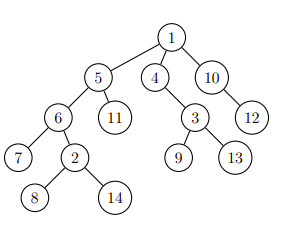
Which of the following cannot be an edge in the original graph?
Status: Yes, the answer is correct.
Score: Score: 1
Feedback/Explanation:
Accepted Answers:
Question 5
Which of the following graphs satisfies the below properties:
1. = , where is the minimum vertex cover of a graph
2. = , where is the perfect matching of a graph
3. The graph is a 3-colouring.
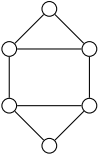
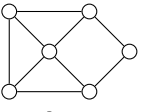
Feedback/Explanation:
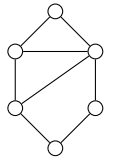
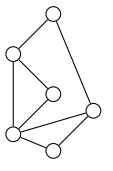
Accepted Answers:
Question 6
Which of the following statements is(are) true?
- BFS can be used to identify the vertex which is at the farthest distance from in any graph, in terms of number of edges, where vertex is the starting vertex.
- BFS and DFS identifies all the vertices reachable from the starting vertex
- BFS cannot be used to check for cycles in the graph while DFS can be used to check for cycles in the graph.
- DFS can be used to identify the shortest distance from starting vertex to every other vertex in the graph, in terms of number of edges.
Status: Yes, the answer is correct.
Score: Score: 1
Feedback/Explanation:
BFS can be used to identify the vertex which is at the farthest distance from in any graph, in terms of number of edges, where vertex is the starting vertex.
BFS and DFS identifies all the vertices reachable from the starting vertex
Accepted Answers:
BFS can be used to identify the vertex which is at the farthest distance from in any graph, in terms of number of edges, where vertex is the starting vertex.
BFS and DFS identifies all the vertices reachable from the starting vertex
Question 7
If A =
represents adjacency matrix of a graph then the cardinality of the maximum independent set of the graph is
Your Answer:
3Feedback/Explanation:
(Type: Numeric) 5
Accepted Answers:
(Type: Numeric) 5
Question 8
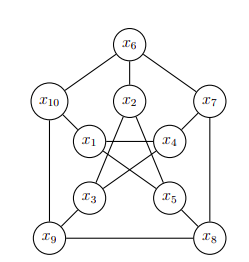
A company manufactures chemicals Certain pairs of these chemicals are incompatible and would cause explosions if brought into contact with each other. Below graph shows the incompatibility of the chemicals, each vertex represents the chemical and each edge between a pair of chemicals represents that those two chemicals are incompatible. As a precautionary measure the company wishes to partition its warehouse into compartments, and store incompatible chemicals in different compartments. What is the least number of compartments into which the warehouse should be partitioned?
Your Answer:
3Status: Yes, the answer is correct.
Score: Score: 1
Feedback/Explanation:
(Type: Numeric) 3
Accepted Answers:
(Type: Numeric) 3
Question 9
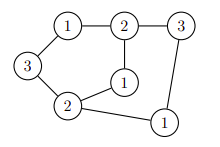
An incomplete undirected graph is given below and the numbering on each vertex denotes the colouring of the graph('' denotes color 1, ‘’ denotes color , and ‘’ denotes color ). Find the number of maximum edges that can be added to the given graph such that the colouring is retained and the graph is planar.
NOTE: Planar graph is a graph that can be drawn on the plane in such a way that its edges intersect only at their endpoints.
Your Answer:
0Feedback/Explanation:
(Type: Numeric) 6
Accepted Answers:
(Type: Numeric) 6