Neural Sync Active
Week 4 - Graded Assignment 4
Registry Synced
Week 4 - Graded Assignment 4
3937 words
20 min read
Course: Jan 2026 - Mathematics I
Topic: Graphical representation of rational functions | Marks: 3
Question 1
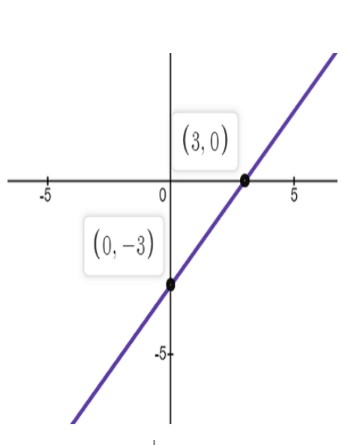
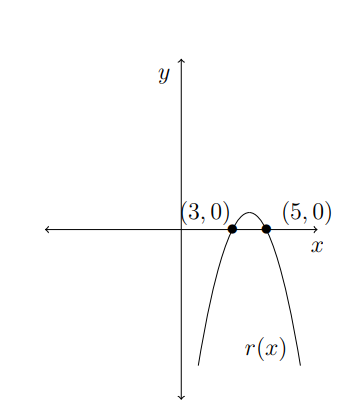
Consider the line () and parabola () as shown in below figure.
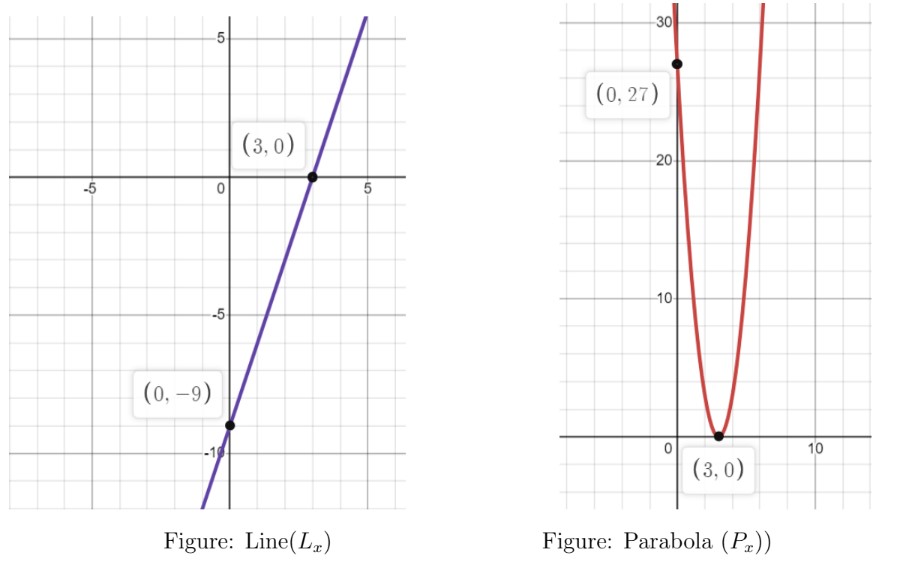
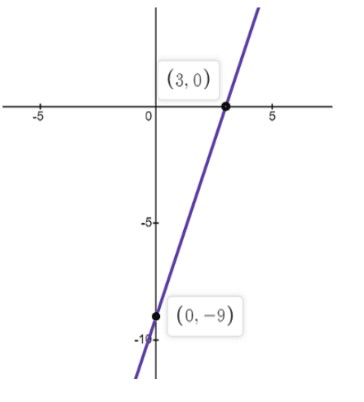
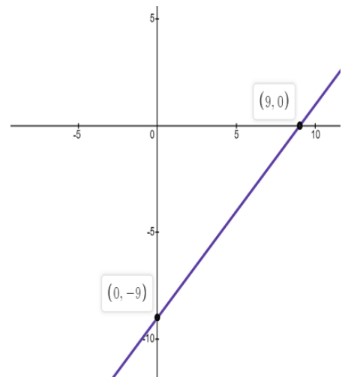
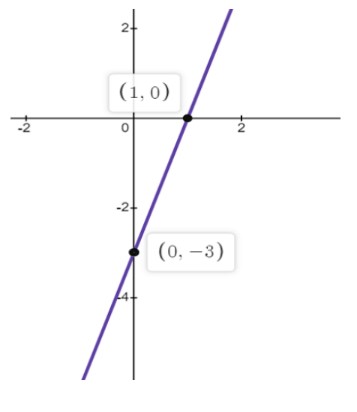
Which among the following represents the graph of ?
Solution
Abstract Solution (Strategy)
- Common Factor Identification: If the line is a factor of the parabola , then will be a linear function (straight line).
- Roots Comparison: If has a root at , and has roots at and , the quotient for .
- Discontinuity: Note the removable discontinuity (hole) at . ^maths-w4-q1-strategy
Procedure
- Parabola has roots at and (from graph).
- Line has a root at (passes through ).
- . .
- .
- This represents a straight line with an -intercept at .
- The graph in the accepted answer shows exactly this linear behavior.
Accepted Answers:
Topic: Sign scheme and roots of polynomials | Marks: 3
Question 2
Consider and , whose one of the roots are given in the set . Choose the set of correct options regarding and .
- The cuts the X-axis at 3, 5 and 4.
- The cuts the X-axis at 2, -6 and -1.
- If , then is positive.
- is negative when .
- is positive when .
Solution
- Factorization: Use the candidate roots to find one factor, then perform division to find the remaining quadratic.
- Sign Scheme: Determine intervals where the function is positive/negative by plotting roots on a number line. ^maths-w4-q2-strategy
Procedure
- For : .
- is a factor. Dividing by gives .
- Roots: .
- For : .
- is a factor. Dividing by gives .
- Roots: .
- Statement "The cuts the X-axis at 2, -6 and -1" is correct.
Accepted Answers:
The cuts the X-axis at 2, -6 and -1.
Topic: Building polynomials from sign behavior | Marks: 3
Question 3
Consider a polynomial function of degree 4 which intersects the X-axis at and . Moreover, when , and when . Find out the equation of the polynomial
Solution
- Identify Roots: Given roots are . For a degree 4 polynomial, there must be a 4th root or one root must have multiplicity 2.
- Sign Analysis: for means at , .
- Check Options: Multiply the factors to see which one matches the sign behavior. ^maths-w4-q3-strategy
Procedure
- Option 2 expansion: .
- Checking signs:
- If , say : . Correct.
- If , say : . Correct ().
- Therefore, roots are .
Accepted Answers:
Topic: Multiplicity and Turning Points | Marks: 4
Question 4
Consider a polynomial function .
Choose the correct set of options.
Choose the correct set of options.
- The function has exactly 7 turning points.
- The function has exactly 6 points where the slope is 0.
- The function is neither even nor odd function.
- In the interval , is increasing first and then decreasing.
- The function is negative when .
Solution
- Critical Points: Slope is 0 at turning points and at roots with multiplicity .
- Multiplicity Logic: Even multiplicity () means the curve touches the axis (tangential). Odd multiplicity means it crosses.
- Interval Tests: Evaluate sign of in given intervals to determine behavior. ^maths-w4-q4-strategy
Procedure
- Degree of is . Max turning points .
- has roots at .
- Roots with multiplicity : (mult 2), (mult 2). Slope is 0 at these points.
- Excluding these, there are 4 other turning points between the distinct roots. Total points where slope is 0.
- For , test : . Correct.
Accepted Answers:
The function has exactly 6 points where the slope is 0.
The function is neither even nor odd function.
In the interval , is increasing first and then decreasing.
The function is negative when .
Topic: Polynomial Arithmetic and Line Equations | Marks: 3
Question 5
Consider a polynomial function and . If is the equation of the straight line passing through and having slope 3, then find out the equation of .
Choose the correct answer.
Solution
- Find M(x): Calculate , use the point-slope form .
- Substitution: Form the expression .
- Expansion & Collection: Multiply polynomials and combine like terms. ^maths-w4-q5-strategy
Procedure
- . Point: , Slope: .
- .
- .
- .
Accepted Answers:
Topic: Graphical Analysis of Turning Points | Marks: 3
Question 6
Consider the following polynomial whose graph is given below:-
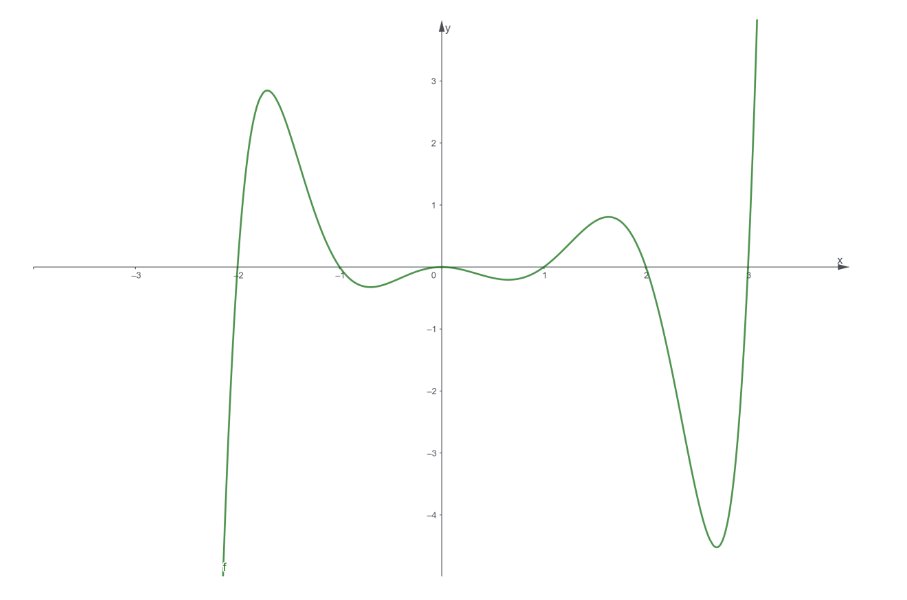
Which of the following options is/are correct?
- Multiplicity of -1 and 1 must be the same.
- is increasing in the interval .
- The total number of local minima is 3.
- The number of turning points is 5.
Solution
- Turning Points Identification: Count every peak (local maximum) and valley (local minimum).
- Multiplicity from Graph: Observe if the graph crosses the X-axis (odd multiplicity) or touches and turns (even multiplicity).
- Interval Analysis: Check the slope of the curve in the given interval to determine if it is increasing or decreasing. ^maths-w4-q6-strategy
Procedure
- Turning Points: From the graph, we see peaks/valleys at approx ? No, looking at the graph, there are 2 hills and 3 valleys. Total = 5 turning points. Correct.
- Local Minima: There are 3 distinct "valleys" at the bottom. Correct.
- Interval : To the right of , the graph moves upwards. Correct.
- Multiplicity: At both and , the graph crosses the axis in a similar way (linear-like crossing). Multiplicity for both is odd (likely 1). Correct.
Accepted Answers:
is increasing in the interval .
The total number of local minima is 3.
Topic: Polynomial End Behavior | Marks: 3
Question 7
Consider two polynomials and . Which of the following options is/are true?
- as .
- as .
- has at most 4 turning points.
- The quotient obtained while dividing by is a constant.
Solution
- End Behavior: Lead term . As , high power dominates with a negative sign.
- Turning Points: For a polynomial of degree , the maximum number of turning points is .
- Division Quotient: When dividing two polynomials of the same degree, the quotient is the ratio of their leading coefficients. ^maths-w4-q7-strategy
Procedure
- End Behavior: . Statement 2 is True.
- Turning Points: Degree is . Max turning points . Statement 3 is True.
- Division: Both and are degree. Quotient = (a constant). Statement 4 is True.
Status: Yes, the answer is correct.
Accepted Answers:
as .
has at most 4 turning points.
The quotient obtained while dividing by is a constant.
Topic: Division and Remainder degree | Marks: 3
Question 8
Consider four polynomials and as follows:
Which of the following options is/are true?
- The degree of is 3.
- The degree of is 5.
- When divides then obtained remainder is a linear function.
- When divides then obtained remainder is a quadratic function.
Solution
- Degree of Sum: .
- Degree of Product: .
- Remainder Theorem: If degree of divisor is , the degree of remainder is at most . ^maths-w4-q8-strategy
Procedure
- . Statement 1 is False.
- . Statement 2 is True.
- Remainder: is degree 2. Any remainder when dividing by must be degree 1 (linear) or 0 (constant). Statement 3 is True.
Status: Yes, the answer is correct.
Accepted Answers:
The degree of is 5.
When divides then obtained remainder is a linear function.
Topic: Roots and Multiplicities | Marks: 3
Question 9
Consider four polynomials and as follows:
Which of the following options is/are true?
- There are 5 distinct roots in .
- There are 3 turning points in .
- Multiplicity of the root 1 is 2 in .
- Multiplicity of the root 3 is 1 in .
Solution
Abstract Solution (Strategy)
- Factor All Polynomials: Express in fully factored form.
- Combine Factors: Form by multiplying the factored forms.
- Count Multiplicities: Sum the exponents of each distinct factor.
Procedure
- .
- .
- .
- .
- Roots: (multiplicity 1 each) and (multiplicity 3).
- Multiplicity of root is indeed 1. Correct.
Accepted Answers:
There are 3 turning points in .
Multiplicity of the root 3 is 1 in .
Topic: Polynomial Inequalities | Marks: 3
Question 10
Ritwik wrote 12 mock tests. His score in each mock test is represented as where represents the mock test number i.e., . He should score 40 or above to pass the assignment. Based on this information, In total, how many mock tests did Ritwik pass?
Solution
- Condition: .
- Inequality Setup: .
- Sign Flip: Subtract 40 and divide by negative constant, which reverses the inequality.
- Interval Solution: Solve the polynomial inequality . ^maths-w4-q10-strategy
Procedure
- .
- .
- Since , we analyze the sign of on a number line.
- when (where roots are ).
- Integers in range that satisfy this: .
- Total tests.
Accepted Answers:
(Type: Numeric) 6
Topic: Function Constraints and Graphing | Marks: 3
Question 11
The polynomial has the following properties:
is an odd-degree polynomial with at least three distinct real roots.
has exactly two distinct positive real roots.
is a factor of .
.
Choose the best possible representations of
Choose the best possible representations of
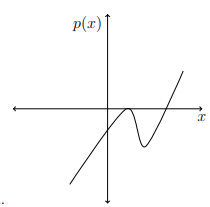
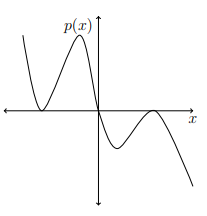
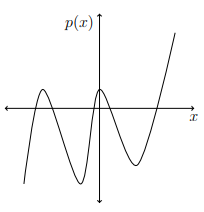
Solution
Abstract Solution (Strategy)
- Factor Analysis: means there is a root at with multiplicity 2 (touches the X-axis).
- Positive Roots: "Exactly two distinct positive roots". Since is one (double), there must be exactly one more distinct root .
- Degree & Roots: "Odd degree" and "at least three distinct real roots".
- Intercept: means it doesn't pass through the origin.
Procedure
- Option 1 shows:
- Touches at (multiplicity 2).
- Crosses at another positive point. (Total 2 distinct positive roots).
- Crosses at a negative point. (Total 3 distinct real roots).
- Doesn't go through origin.
- End behavior (one side up, one side down) indicates odd degree.
- This perfectly matches all constraints.
Accepted Answers:
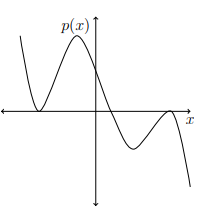
Topic: Rational Function Simplification | Marks: 3
Question 12
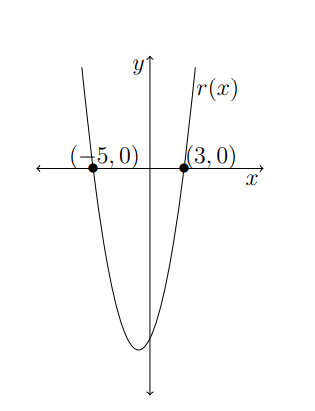
Let be a polynomial function which is obtained as the quotient after dividing the polynomial by the polynomial . Choose the correct option which represents the polynomial most appropriately.
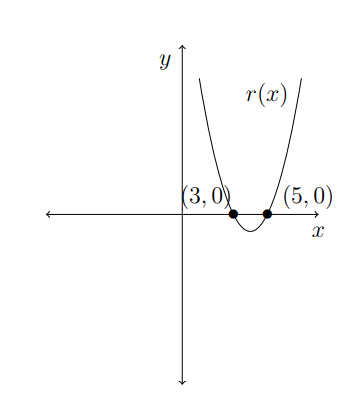
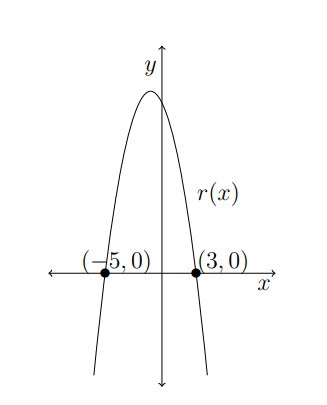
Solution
Abstract Solution (Strategy)
- Factorization: Rewrite all quadratic terms into linear factors.
- Simplification: Cancel out common factors from numerator and denominator.
- Graphing: Identify roots of the remaining polynomial and check its end behavior.
Procedure
- .
- .
- .
- This is a parabola opening upwards with roots at and .
- Option 1 shows this parabola.
Accepted Answers:
Topic: SSE Minimization and Arithmetic Mean | Marks: 4
Question 13
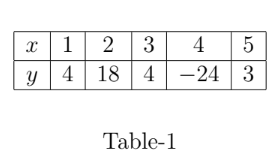
A function which is the best fit for the data given in the Table-1 recorded by a student, is What will be the value of , so that SSE (Sum Squared Error) will be minimum?
Solution
Abstract Solution (Strategy)
- Model Property: At points , the predicted value is exactly because the product term becomes zero.
- SSE Minimization: For a set of observed values at these points, the constant that minimizes is simply the arithmetic mean of the values. ^sse-minimization-logic
Procedure
- Observed values at from Table-1: .
- Mean .
- Therefore, minimizes SSE.
Accepted Answers:
(Type: Numeric) 3.4
Topic: Applied Polynomial Geometry | Marks: 3
Question 14
A company is manufacturing custom-made boxes with a volume represented by the polynomial . If the length of each box is represented by the polynomial , given that width and height of the box are and respectively. Also given that for all , , the Degree of polynomials and is 1.
Polynomial expression which represents area of the base.
Polynomial expression which represents area of the base.
Solution
Abstract Solution (Strategy)
- Division: Volume Length Width Height. First divide by to get the Area of the other two dimensions ().
- Factorization: Factor the resulting quadratic into two linear terms and .
- Identification: Identify "Base Area" (typically Length Width).
Procedure
- (via synthetic division).
- Factor : find numbers that sum to 12 and multiply to 20 .
- .
- Since for , and .
- Base Area () .
Accepted Answers:
Topic: Polynomial Modeling | Marks: 3
Question 15
A telecommunications company observes that the number of monthly subscribers (S) for its internet service can be modeled by the polynomial function , where t represents the number of months since the service was launched.
The company aims to reach a milestone of 5000 subscribers. How many months will it take to achieve this goal based on the polynomial function? (Note: )
The company aims to reach a milestone of 5000 subscribers. How many months will it take to achieve this goal based on the polynomial function? (Note: )
Solution
Abstract Solution (Strategy)
- Equation Setup: Set .
- Solve for t: Simplify the equation and find the positive integer root for .
Procedure
- .
- .
- .
- For , the only valid solution is months.
Accepted Answers:
(Type: Numeric) 6
Topic: Function Definitions and Zeros | Marks: 3
Question 16
Which of the following is/are correct ?
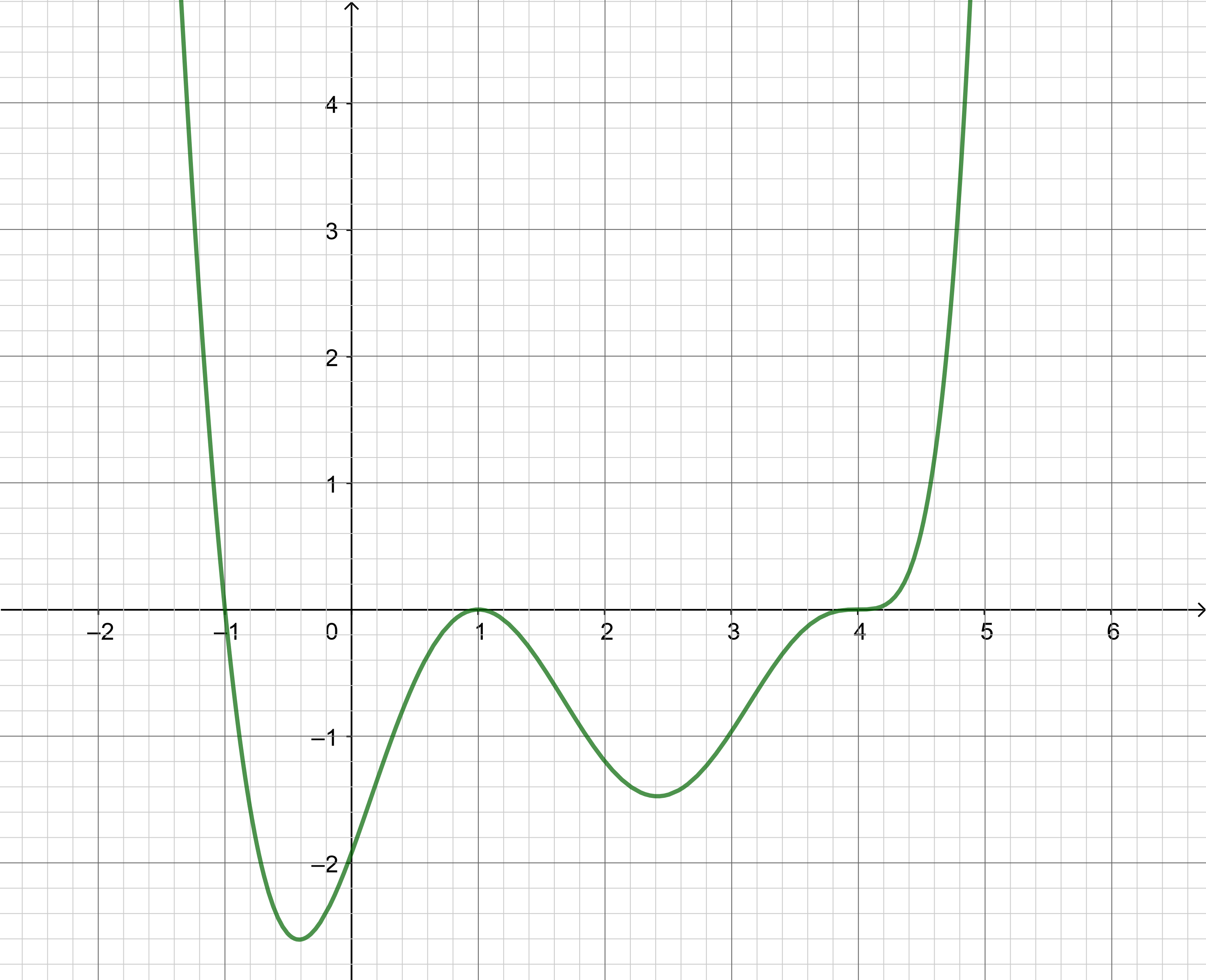
Fig - 1
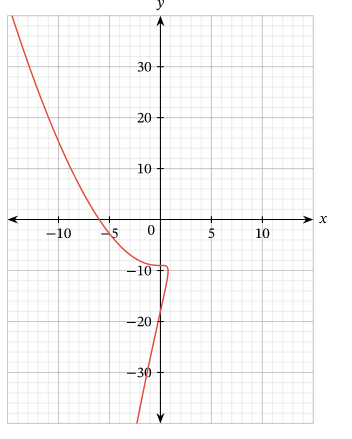
Fig - 2
- Fig - 1 and Fig - 2 are polynomials of .
- The polynomial of $x that represents the Fig - 1 have minimum 6 Zeros
- The polynomial of $x that represent the Fig - 2 have minimum 3 Zeros
- Fig - 2 represents the function of .
- Fig - 2 is not a polynomial of .
- The polynomial of that represents the Fig - 1 have 3 distinct Zeros
Solution
Abstract Solution (Strategy)
- Vertical Line Test: If any vertical line intersects the curve more than once, it is not a function of .
- Polynomial Continuity: Polynomials are smooth, continuous, and defined everywhere. Sharp corners or cusps (like in Fig 2) indicate absolute values or piecewise functions, not simple polynomials.
- Roots vs Maxima: Distinct zeros are where it crosses the axis. Minimum degree is related to turning points ().
Procedure
- Fig 1:
- Crosses the axis at 3 points. (3 distinct zeros).
- Has 5 turning points. Polynomial degree is at least . (Minimum 6 complex zeros). Correct.
- Fig 2:
- Passes Vertical Line Test is a Function. Correct.
- Has sharp corners (v-shapes). Simple polynomials cannot have sharp corners. Correct.
Accepted Answers:
The polynomial of that represents the Fig - 1 have minimum 6 Zeros
Fig - 2 is not a polynomial of .
The polynomial of that represents the Fig - 1 have 3 distinct Zeros
Topic: Monotonicity and Multiplicity | Marks: 3
Question 17
The height of a roller coaster at a given time is modeled by the polynomial function , where t represents time in seconds. Choose the correct options based on the data given in question.
- The roller coaster will first go up and then go down in the interval .
- The roller coaster will first go down and then go up in the interval .
- The roller coaster will first go up and then go down in the interval .
- The roller coaster will first go up and then go down in the interval .
Solution
Abstract Solution (Strategy)
- Analyze Zeroes: Roots are segments where the graph crosses or touches.
- Multiplicity behavior:
- : touches at (even).
- : crosses at (odd).
- : crosses at (odd, cubic flattening).
- : crosses at (odd).
- Cubic Term: factor also has roots. Testing values in intervals is safest.
Procedure
- Term 1: . At , it's zero? . So is a root.
- Interval : Touches at , crosses at . Between these, it must peak. Correct.
- Interval : Crosses at both points. Between them it peaks. Correct.
Accepted Answers:
The roller coaster will first go up and then go down in the interval .
The roller coaster will first go down and then go up in the interval .
The roller coaster will first go up and then go down in the interval .
Topic: Turning Points and Inflection Points | Marks: 4
Question 18
The height of a roller coaster at a given time is modeled by the polynomial function , where t represents time in seconds. Find the turning point(s) of the height function.
- 6
- 7
- 5
- 8
Solution
Abstract Solution (Strategy)
- Degree Calculation: Sum all the powers in the factored expression.
- Turning Points Rule: Polynomial of degree has exactly points where the derivative is zero (slope 0).
Procedure
- Term 1 (Cubic): Degree 3.
- : Degree 2.
- : Degree 1.
- : Degree 1.
- : Degree 3.
- Total Degree .
- Turning Points (stationary points) ?
- Wait, the question asks for "turning points" (peaks/valleys). If roots have even multiplicity or are inflection points, they count as slope-0 points but not necessarily turning points.
- Stationary points = 9. But is an inflection point (degree 3). It isn't a "turning point".
- Stationary points .
Accepted Answers:
7
🧭 Navigation
- 📘 Textbook Notes: Week 4 Notes
- 📝 Assignment: Week 4 Assignment
- ⬅️ Previous Week: Week 3 Notes