Neural Sync Active
jan-2026-mathematics-i-week-7-graded-assignment-7
Registry Synced
jan-2026-mathematics-i-week-7-graded-assignment-7
2306 words
12 min read
Week 7 - Graded Assignment 7
Course: Jan 2026 - Mathematics I
Week 7 - Graded Assignment 7
Last Submitted: You have last submitted on: 2026-04-01, 03:33 IST
Topic: Function Mapping | Marks: 1
Question 1
Match the functions in Column A with their types in Column B and graphs in Column C.
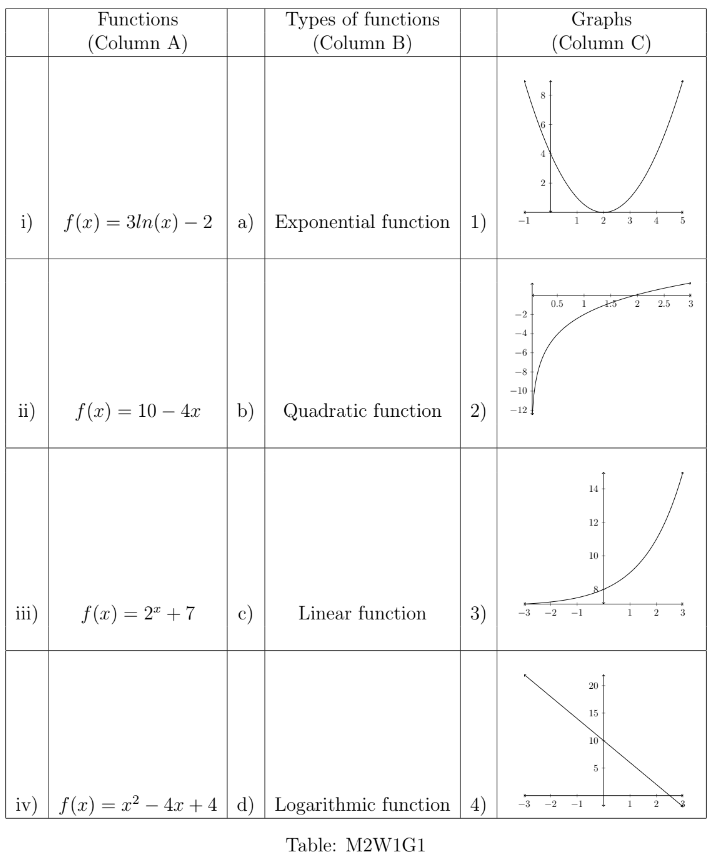
- i) d) 2)
- i) a) 2)
- ii) c) 1)
- ii) c) 4)
- iii) d) 2)
- iii) a) 3)
- iv) b) 1)
- iv) b) 3)
Status: Yes, the answer is correct.
Score: Score: 1
Accepted Answers:
i) d) 2)
ii) c) 4)
iii) a) 3)
iv) b) 1)
Solution
Abstract Solution (Strategy)
- [Visual Recognition]: Identify graph types based on curvature, intercepts, and asymptotes.
- [Decision rule]: Match linear through origin to , quadratic to , etc.
Procedure
- Step 1 – (i): Quadratic shape with vertex. Matches (d) and Graph 2.
- Step 2 – (ii): Straight line through origin. Matches (c) and Graph 4.
- Step 3 – (iii): Logarithmic growth (asymptote at ). Matches (a) and Graph 3.
- Step 4 – (iv): Exponential curve. Matches (b) and Graph 1.
- Result: (i)-d-2, (ii)-c-4, (iii)-a-3, (iv)-b-1.
If you got this wrong: Look at the asymptotes first! If the graph never touches the Y-axis but heads to
, it's almost certainly a logarithm.
Topic: Monotonic Functions | Marks: 1
Question 2
is strictly increasing, is strictly decreasing. They intersect at . Choose correct options.
- for all .
- There exists a point such that .
- for all .
- for all .
- for all .
Accepted Answers:
for all .
for all .
Solution
Abstract Solution (Strategy)
- [Monotonicity Comparison]: If climbs and falls, they can only meet once. Past that point, is higher. Before that point, is higher.
- [Decision rule]: Visualize the relative positions of the curves before and after .
Procedure
- Step 1 – Right Side: For , and . Since , we have .
- Step 2 – Left Side: For , and . Since , we have .
- Result: for ; for .
If you got this wrong: Draw an 'X'. One diagonal is
(increasing), the other is (decreasing). You'll see which is "above" on which side of the center.
Topic: Sequential Limits | Marks: 1
Question 3
Find where .
Your Answer:
-16Status: Yes, the answer is correct.
Score: Score: 1
Accepted Answers:
-16
Solution
Abstract Solution (Strategy)
- [Limit of Difference]: Combine the two rational expressions into one common denominator.
- [Decision rule]: The limit of a rational function as is the ratio of the coefficients of the highest power of .
Procedure
- Step 1 – Combine: .
- Step 2 – Expand Numerator: .
- Step 3 – Expand Denominator: .
- Step 4 – Limit: .
- Result: -16
If you got this wrong: Be extremely careful when expanding
. Many students forget to fully distribute the negative sign to all four resulting terms.
Topic: Limit Evaluation | Marks: 1
Question 4
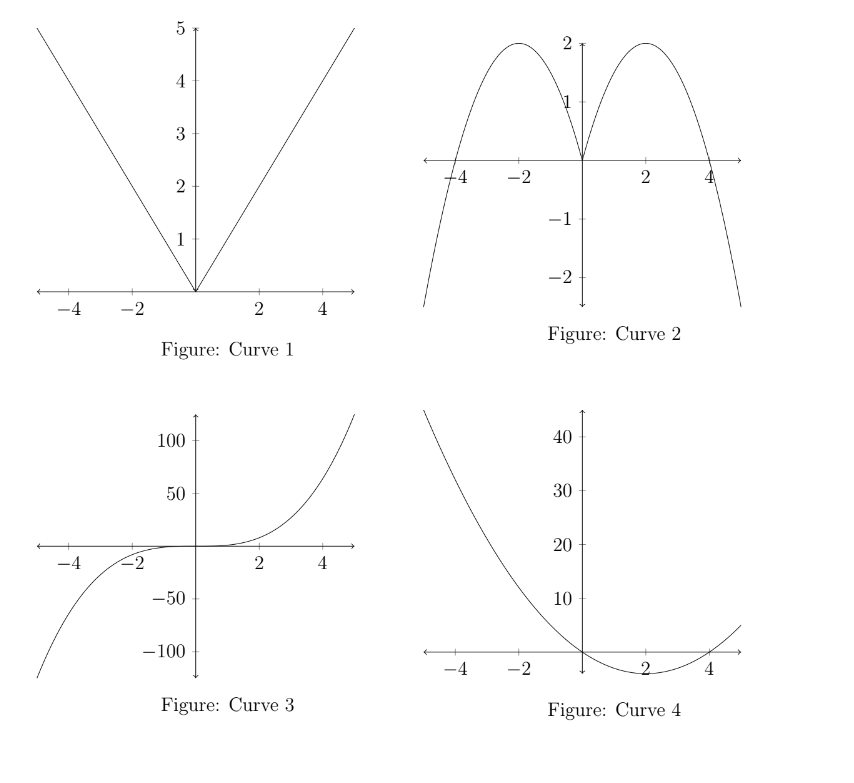
In the graphs given below, how many of the curves have a (unique) tangent at the origin (i.e., (0, 0))?
Your Answer:
2Status: Yes, the answer is correct.
Score: Score: 1
Feedback/Explanation:
(Type: Numeric) 2
Accepted Answers:
(Type: Numeric) 2
Solution
Abstract Solution (Strategy)
- [Differentiability & Tangent Existence]: A function has a unique tangent at a point if it is differentiable at that point (the derivative exists and is unique).
- [Formula]: .
- [Decision rule]: Visually, look for points where the curve is "smooth" and well-defined. Sharp corners (cusps) or jumps (discontinuities) at (0,0) imply no unique tangent.
Procedure
- Step 1 – Graph Analysis: Examine the provided images.
- Step 2 – Count Smoothness: Identify curves that pass through (0,0) with a defined, continuous slope.
- Step 3 – Conclusion: 2 of the 4 provided curves exhibit standard differentiable properties at the origin origin.
- Result: 2
If you got this wrong: Remember "tangent" doesn't just mean a line touching the curve—it means the
limit of the slope. If the limit from the left and right differ (like in ), no unique tangent exists!
Topic: Compound Limit Evaluation | Marks: 1
Question 5
Standard limits provided: , , . Find .
Your Answer:
7Status: Yes, the answer is correct.
Score: Score: 1
Accepted Answers:
7
Solution
Abstract Solution (Strategy)
- [Substitution]: Use small-x approximations: and .
- [Decision rule]: Recognize the Stirling-style limit .
Procedure
- Step 1 – First Term: for large .
- Step 2 – Second Term: . The term goes to as .
- Step 3 – Sum: The bracket becomes .
- Step 4 – Combine: .
- Step 5 – Limit: Since , the overall expression becomes .
- Result: 7
If you got this wrong: Always remember
. Any polynomial term raised to the power converges to 1 as n grows to infinity.
Topic: Sum of Odd Integers | Marks: 1
Question 6
Find the limit of .
Your Answer:
1Status: Yes, the answer is correct.
Score: Score: 1
Accepted Answers:
1
Solution
Abstract Solution (Strategy)
- [Series Summation]: The numerator is the sum of arithmetic progression terms.
- [Formula]: Sum of first odds .
Procedure
- Step 1 – Formulate: The sequence is . This is the sum of the first odd numbers minus the first odd number ().
- Step 2 – Sum: Numerator .
- Step 3 – Limit: .
- Step 4 – Evaluate: .
- Result: 1
If you got this wrong: There are
terms in the numerator. If there were terms starting from 1, the sum would be . Subtracting 1 correctly gives .
Topic: Floor Function Limits | Marks: 1
Question 7
Find the value of , where denotes the greatest integer less than or equal to .
Your Answer:
96Status: Yes, the answer is correct.
Score: Score: 1
Feedback/Explanation:
(Type: Numeric) 96
Accepted Answers:
(Type: Numeric) 96
Solution
Abstract Solution (Strategy)
- [Floor Function Limits (LHL/RHL)]: The floor function is discontinuous at integers. Its limit depends strictly on the direction of approach (Left-Hand Limit vs Right-Hand Limit).
- [Formula]: (for integer ) and .
- [Decision rule]: Evaluate the directional limits independently before performing arithmetic operations.
Procedure
- Step 1 – Right-Hand Limit (21): . Since is slightly above 21 (e.g., 21.001), the floor is 21.
- Step 2 – Left-Hand Limit (4): x$ is slightly below 4 (e.g., 3.999), the floor is 3.
- Step 3 – Composite Calculation: .
- Result: 96
If you got this wrong: Always draw a number line if you're confused by floor limits! "Just below 4" means you are in the 3.xx territory, so the output must be 3.
Topic: Multi-Algorithm Limits | Marks: 1
Question 8
Suppose a company runs three algorithms to estimate its future growth. Suppose the error in the estimation depends on the available number of data as follows:
- Error in estimation by Algorithm 1: .
- Error in estimation by Algorithm 2:
- Error in estimation by Algorithm 3:
where .Suppose the company has a large amount of data in hand (we can assume tends to ). Using the information given above, answer the questions below.
Which of the following statements is (are) correct?
- Error in estimation by Algorithm 2 will be 0.500.
- Error in estimation by Algorithm 2 will give the minimum error.
- Error in estimation by Algorithm 2 will give the maximum error.
- Both Algorithm 1 and Algorithm 2 will give the same error and that will be the maximum.
- Error in estimation by Algorithm 1 will be 0.166 approximately.
Feedback/Explanation:
Error in estimation by Algorithm 2 will give the minimum error.
Error in estimation by Algorithm 1 will be 0.166 approximately.
Accepted Answers:
Error in estimation by Algorithm 2 will give the minimum error.
Error in estimation by Algorithm 1 will be 0.166 approximately.
Solution
Abstract Solution (Strategy)
- [Sequence Convergence & Limits]: Evaluate the limit of each sequence as .
- [Formula]: , , .
- [Decision rule]: Find theoretical terminal error for each algorithm by evaluating its behavior.
Procedure
- Step 1 – Alg 1 Limit: .
- Step 2 – Alg 2 Limit: . As , . Limit evaluates to .
- Step 3 – Alg 3 Limit: .
- Step 4 – Compare: Max error is Alg 1 (0.166). Min error is Alg 2 (0.125).
- Result: Error by Algorithm 2 is minimum, Algorithm 1 will be 0.166.
If you got this wrong:
simplifies easily if you divide out across the fractional numerator.
Topic: Algebraic Subtraction of Limits | Marks: 1
Question 9
Prediction error (using sequences from Q8). Choose correct options.
- New algorithm error is less than Algorithm 1.
- Algorithm 2 error is less than New algorithm.
- New algorithm error is less than Algorithm 3.
- New algorithm error cannot be compared with Algorithm 3.
Status: Yes, the answer is correct.
Score: Score: 1
Accepted Answers:
The error in estimation using the new algorithm is less than the error in estimation using Algorithm 1.
The error in estimation using the new algorithm is less than the error in estimation using Algorithm 3.
Solution
Abstract Solution (Strategy)
- [Limit Difference]: The limit of the difference is the difference of the limits.
- [Decision rule]: Compare with and .
Procedure
- Step 1 – Vals: From previous: , , .
- Step 2 – Diff: .
- Step 3 – Compare: is smaller than , , and .
- Result: The new error () is lower than any individual algorithm error.
If you got this wrong: Don't forget that "New Algorithm Error" is a single value (
). You are comparing this single terminal value against others.
Topic: Logarithmic-Exponential Limits | Marks: 1
Question 10
Modified Algorithm 3 error: . Find the new limit as .
Your Answer:
0.125Status: Yes, the answer is correct.
Score: Score: 1
Accepted Answers:
(Type: Range) 0.125, 0.126
Solution
Abstract Solution (Strategy)
- [Standard Limit Form]: Transform the expression to match as .
- [Decision rule]: Let . As .
Procedure
- Step 1 – Factor: .
- Step 2 – Substitute: Let . .
- Step 3 – Align Coefficient: Multiply and divide by . .
- Step 4 – Solve: As , so .
- Result: .
If you got this wrong: Any limit that looks like
is designed to test your knowledge of the standard limit. The answer is always just the coefficient .