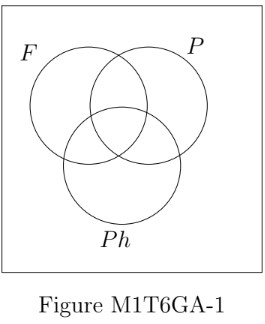
A survey was conducted on pollution of 525 ponds across some cities. It was found that 230 ponds are polluted by fertilisers (F), 245 ponds are polluted by pesticides (P) and 257 ponds are polluted by pharmaceutical products (Ph). 100 ponds are polluted by fertilisers and pesticides, 82 ponds are polluted by fertilisers and pharmaceutical products, 77 ponds are polluted by pesticides and pharmaceutical products.
Define a relation on the set of 525 ponds such that two ponds are related if both are polluted by fertilisers and pharmaceutical products. Which of the following is/are true?
Type: MSQ | Marks: 1 | Topic: Relations
MCQ
Set Theory and Relations
3 Unit Assessment
A
Relation is reflexive.
B
Relation is transitive.
C
Relation is symmetric.
D
This is an equivalence relation.
Topic: Identity Relations and Functions | Marks: 1
Question 2
Consider the relation R={(x,y)∣x−y=0}⊂R×R on the set R. Which of the following is/are true?
Type: MSQ | Marks: 1 | Topic: Relations
MCQ
Set Theory and Relations
3 Unit Assessment
A
R is a transitive relation.
B
R is a function.
C
R is not an equivalence relation.
D
R is a reflexive relation.
E
R is a symmetric relation.
Topic: Injective (One-One) Functions | Marks: 1
Question 3
Which of the following relations is/are one-one function?
Type: MCQ | Marks: 1 | Topic: Functions
MCQ
Set Theory and Relations
3 Unit Assessment
A
R1={(x,y)∣x,y∈R,x+y>2}
B
R2={(x,y)∣x,y∈R,x>y}
C
R3={(x,y)∣x,y∈R,x+y=12}
D
R4={(x,y)∣x,y∈R,y=x2}
Topic: Surjective (Onto) and Piecewise Functions | Marks: 1
Question 4
Which of the following is/are true?
Type: MSQ | Marks: 1 | Topic: Functions
MCQ
Set Theory and Relations
3 Unit Assessment
A
Function f:N→R such that f(x)=x2 is not onto.
B
Relation R={(1,1),(1,2),(3,1)} on a set A={1,2,3} is a function.
C
Function f:R→R such that f(x)=∣x∣ is not one-one.
D
Function f:R→R such that f(x)=(x−1)2 is one-one and onto.
Topic: Set Cardinality and Regions | Marks: 1
Question 5
Consider the following sets, A={x∣x∈N} B={x∣−5<x<105,x∈R} C={x∣xis a rational number,10<x≤80}
Find the cardinality of the set (A−C)∩B.
Type: NAT | Marks: 1 | Topic: Set Theory
MCQ
3 Unit Assessment
Reference-only archive item
The completed export preserved the prompt as an image but not a reusable answer key. The reconstruction below is for study, not scoring.
Study reconstruction
Accepted Answer: 35Abstract Solution (Strategy):
Set Difference (A−C): Remove elements from A that are also in C. Since A is N and C contains rationals between 10 and 80, this removes all natural numbers x such that 10<x≤80.
Intersection with B: Restrict the remaining set to the range (−5,105).
Sum the Counts: Count natural numbers in the distinct segments.
^maths-w1-q5-strategy
Procedure:
A={1,2,3,...} (Note: In IITM Maths 1, N usually starts from 1, but sometimes 0 is included. Let's verify: ∣(A−C)∩B∣).
C removes integers {11,12,...,80} from N.
Remaining in A: {1,2,...,10,81,82,...}.
Intersection with B ((−5,105)): {1,2,...,10}∪{81,82,...,104}.
Count in {1...10}=10.
Count in {81...104}=104−81+1=24.
Total = 10+24=34.
Wait, Check IITM definition of N: If the accepted answer is 35, it implies N={0,1,2,...}.
Then {0,1,...,10} has 11 elements. 11+24=35.
Topic: Principle of Inclusion-Exclusion (PIE) | Marks: 1
Question 6
A survey was conducted on pollution of 525 ponds across some cities. It was found that 230 ponds are polluted by fertilisers (F), 245 ponds are polluted by pesticides (P) and 257 ponds are polluted by pharmaceutical products (Ph). 100 ponds are polluted by fertilisers and pesticides, 82 ponds are polluted by fertilisers and pharmaceutical products, 77 ponds are polluted by pesticides and pharmaceutical products.
Find the number of ponds polluted by all types of water contaminants.
Type: NAT | Marks: 1 | Topic: Set Theory
MCQ
3 Unit Assessment
Reference-only archive item
The completed export preserved the prompt as an image but not a reusable answer key. The reconstruction below is for study, not scoring.
Study reconstruction
Accepted Answer: 52Abstract Solution (Strategy):
Principle of Inclusion-Exclusion (PIE): Use the formula for 3 sets:
∣A∪B∪C∣=∣A∣+∣B∣+∣C∣−(∣A∩B∣+∣B∩C∣+∣C∩A∣)+∣A∩B∩C∣.
Plug and Chug: Assuming all ponds are polluted by at least one (since no "none" is mentioned and total is 525).
^maths-w1-q6-strategy
f:P→Q is a function, where P={Yashubh, Navrtna, Rathi, Rakesh, Mahesh} and Q={ Shubh, Rabi, Mahendra, Rajat}.
B
If f:P→Q is a function, where P={ Yashubh, Navrtna, Rathi, Rakesh} and Q={Shubh, Rabi, Mahendra, Rajat}, then f is one-one.
C
If f:P→Q is a function, where P={Yashubh, Navrtna, Rathi, Rakesh} and Q={ Shubh, Rabi}, then f is onto.
D
If f:P→Q is a function, where P={Yashubh, Rathi} and Q={Shubh, Rabi}, then f is bijective.
Topic: Domains and Codomains | Marks: 1
Question 8
Consider the table of materials and dielectric constants.
Material
Dielectric constant
Air
1
Vaccum
2
Paper
3
Glass
8
Nerve membrane
7
Silicon
13
Let f be a function from the set of materials to the set of dielectric constants. Which of the following is true?
Type: MCQ | Marks: 1 | Topic: Functions
MCQ
Set Theory and Relations
3 Unit Assessment
A
f is neither one to one nor onto.
B
f is one to one but not onto.
C
f is onto but not one to one.
D
f is bijective.
Topic: Symmetric Difference of Sets | Marks: 1
Question 9
Consider the following sets.
A={x∈N∣x mod 2=0 and 1≤x≤10}
B={x∈N∣x mod 5=0 and 6≤x≤25}
C={x∈N∣x mod 7=0 and 7≤x≤29}
What is the cardinality of (A∖(B∪C))∪(B∖(C∪A))∪(C∖(B∪A))
Type: NAT | Marks: 1 | Topic: Set Theory
MCQ
3 Unit Assessment
Reference-only archive item
The completed export preserved the prompt as an image but not a reusable answer key. The reconstruction below is for study, not scoring.
Study reconstruction
Accepted Answer: 11Abstract Solution (Strategy):
List all elements: Explicitly write down the elements of A,B,C.
Apply Set Difference: For each set, remove elements found in the other two.
Symmetric Difference logic: This expression represents elements belonging to exactly one of the three sets.
Procedure:
A={2,4,6,8,10}
B={10,15,20,25}
C={7,14,21,28}
Excluded by overlapping:A \cap B = \{10\}$$B \cap C = \emptyset$$A \cap C = \emptyset
Single membership sets:A∖(B∪C)={2,4,6,8} (4 elements)B∖(C∪A)={15,20,25} (3 elements)C∖(B∪A)={7,14,21,28} (4 elements)
Total cardinality = 4+3+4=11.
Topic: Multi-set Overlap Word Problems | Marks: 1
Question 10
In 180 people survey: 95 watched Dabangg, 100 watched Avatar, 100 watched RRR. Intersections: Dabangg ∩ Avatar = 50, Avatar ∩ RRR = 40, Dabangg ∩ RRR = 55. If all 180 people watched at least one movie, find the number of people who watched only RRR and Avatar but not Dabangg.
Type: NAT | Marks: 1 | Topic: Set Theory
MCQ
3 Unit Assessment
Reference-only archive item
The completed export preserved the prompt as an image but not a reusable answer key. The reconstruction below is for study, not scoring.
Study reconstruction
Accepted Answer: 10Abstract Solution (Strategy):
Find ∣all 3∣: Use PIE (180=∑∣Si∣−∑∣Si∩Sj∣+∣S1∩S2∩S3∣).
People who watched only Avatar and RRR = 40−30=10.
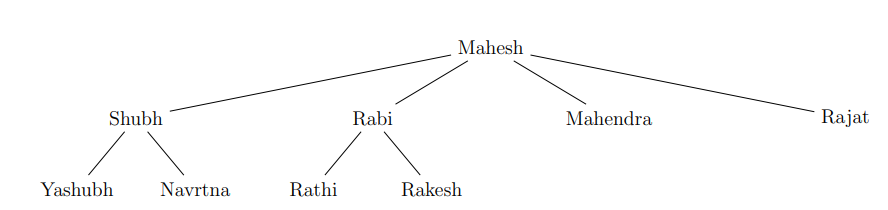
Question 11
Family Tree relations R ("are cousins") and S ("is son of").
Mahesh has four sons (Shubh, Rabi, Mahendra, and Rajat). Shubh has two sons (Yashubh and Navrtna). Rabi has two sons named Rathi and Rakesh.
Which of the following options are correct?
Type: MSQ | Marks: 1 | Topic: Relations
MCQ
Set Theory and Relations
3 Unit Assessment
A
R is an equivalence relation.
B
(Rathi, Navrtna) ∈R
C
S is an equivalence relation.
D
(Mahesh, Rajat) ∈S.
E
(Yashubh, Rathi) ∈R and (Rathi, Yashubh) ∈R.
F
S is symmetric relation.
Question 12
Family Tree: Let m be the number of elements in R (cousins) and n be the number of elements in S (son of). Find m+n.
(Consider the set consisting of all mentioned people).
Type: NAT | Marks: 1 | Topic: Relations
MCQ
3 Unit Assessment
Reference-only archive item
The completed export preserved the prompt as an image but not a reusable answer key. The reconstruction below is for study, not scoring.
Study reconstruction
Accepted Answer: 16Abstract Solution (Strategy):
List S pairs: Count every (child, parent) edge.
List R pairs: Count every (cousin1, cousin2) pair. Note: Relations are sets of ordered pairs (x,y).
Cousin Calculation: If group 1 has x people and group 2 has y people, the number of cousin pairs (g1,g2) and (g2,g1) is 2xy.